
Here's what I've learned from years of fieldwork: kids don't need convincing to go outside — they need a mission. Hand a kid a magnifying glass and a list of things to find, and the tablet gets forgotten on the couch. These are my fifteen favorite no-screen field missions, tested on the toughest critics I know: actual kids.
What are the best outdoor activities for kids?
The best outdoor activities for kids are the ones with a mission: nature scavenger hunts, pond dipping, building bug hotels, backyard birdwatching, stargazing, and tracking animal footprints. Kids stay outside far longer when there's something to find, build, or identify — and nearly all of these need nothing more than a jar, a notebook, and a grown-up.
🔍 Explore missions
1. The great rock flip
Ages 6+ · Needs: gloves, a jar, a grown-up
Flip over rocks and logs to discover pill bugs, beetles, salamanders, and centipedes — an entire hidden neighborhood. Observe, sketch, and gently put everything back exactly as you found it. Rule of the field: you borrowed their roof; return it.
2. Nature scavenger hunt
Ages 5+ · Needs: a checklist, a bag
Make a list — something smooth, something that makes noise, something a bird would eat, something older than you — and race the clock. Scavenger hunts turn any walk, park, or backyard into an expedition with a finish line.
3. Pond dipping
Ages 7+ · Needs: a net, a white tray or bucket, a grown-up
Scoop pond water into a tray and watch it come alive: water boatmen, dragonfly nymphs, tadpoles, maybe a newt. Identify what you find, then release everything back into the pond. It's a safari in a bucket.
4. Track the footprints
Ages 6+ · Needs: soft mud or sand, a notebook
After rain is prime time. Find animal tracks in mud, sketch them, measure them, and work out who passed through — dog, deer, raccoon, heron? Mix plaster of Paris to cast the best ones like a real field researcher.
🔨 Build missions
5. Build a bug hotel
Ages 6+ · Needs: sticks, pinecones, hollow stems, a box or bundle
Stack natural materials into a cozy shelter for solitary bees, ladybugs, and beetles. Place it somewhere sheltered and check in weekly — you'll be amazed how fast tenants move in. Real conservation, built by kid hands.
6. Stick fort engineering
Ages 7+ · Needs: fallen branches, teamwork
Find fallen branches (never break living ones) and engineer a shelter. It teaches structural thinking the fun way — when the roof collapses, you learn more than when it holds. Every kid engineer needs a failed fort story.
7. Plant a seed, run an experiment
Ages 5+ · Needs: seeds, soil, cups
Beans are the classic: they sprout fast enough to hold a kid's attention. Plant three cups — one in light, one in dark, one with no water — and track the results daily. That's the scientific method, growing on a windowsill.
👀 Watch missions
8. Backyard bird stakeout
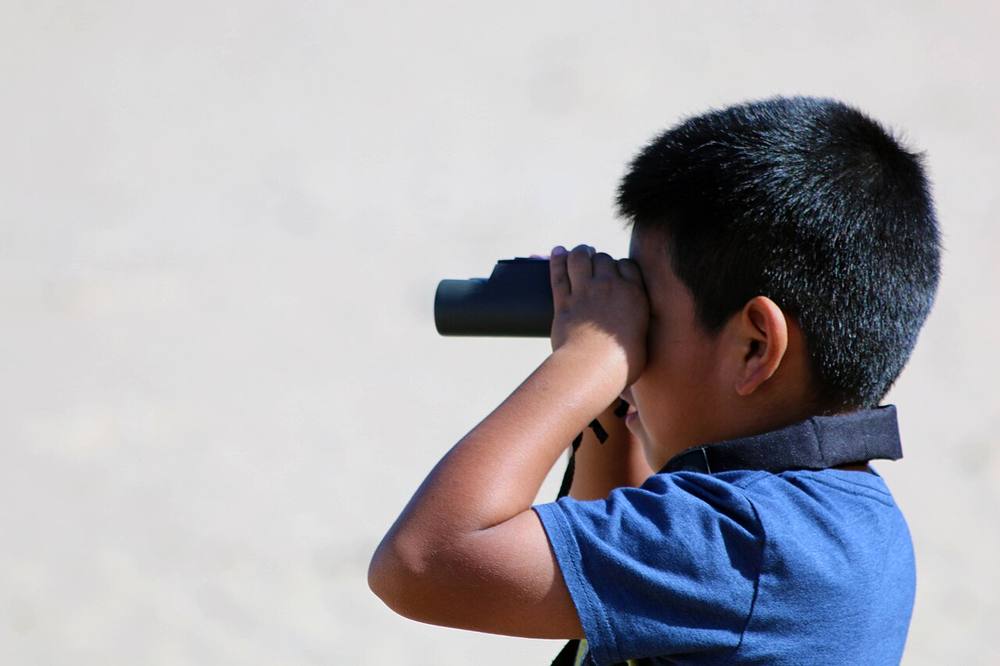
Ages 6+ · Needs: binoculars (optional), a journal
Pick a spot, sit still for ten minutes, and log every bird you see and hear. Start with the easy five in our kid's guide to backyard birds — robins, cardinals, blue jays, chickadees, and goldfinches. Quiet watchers see the most.
9. Night safari with flashlights
Ages 7+ · Needs: flashlights, a grown-up, a backyard or park
The world changes after dark. Shine lights on white sheets to attract moths (dozens of species in one night), listen for owls, and watch spiders' eyes glitter in the beam. Same backyard, totally different planet.
10. Cloud and weather watch
Ages 5+ · Needs: a blanket, curiosity
Lie back and learn the cloud families — wispy cirrus, puffy cumulus, flat stratus. Then start predicting tomorrow's weather from today's sky and check your forecast against reality. Meteorologist training, zero equipment.
11. Stargazing
Ages 6+ · Needs: dark sky, a blanket, a grown-up
Learn three constellations and find them yourself — the Big Dipper, Orion, Cassiopeia. Count satellites drifting overhead, watch for the International Space Station, and make up your own constellations from the leftover stars.
🎨 Create & record missions
12. Leaf and bark rubbings
Ages 5+ · Needs: paper, crayons
Press paper against bark or lay a leaf underneath and rub with a crayon — instant botanical art that also teaches tree ID. Collect rubbings from ten different trees and you've built a field guide of your neighborhood.
13. Sound mapping
Ages 6+ · Needs: paper, pencil
Sit in one spot for five minutes with eyes closed. Mark yourself as an X in the middle of the paper, then draw symbols for every sound you hear, placed by direction and distance. It's mindfulness disguised as cartography.
14. Identify it with Seek
Ages 6+ · Needs: a phone or tablet (camera only!), a grown-up
The one mission where a device helps: point the free Seek app at any plant, bug, or mushroom and it tells you what you're looking at. Read our parent's guide to citizen science first — your kid's observations can help real scientists.
15. Start a nature journal
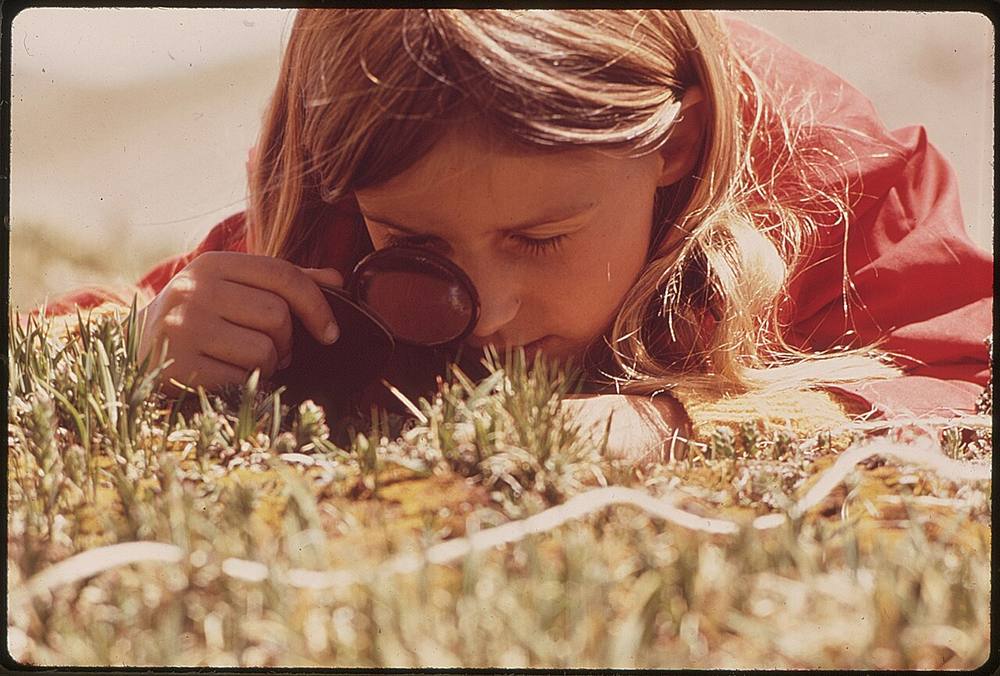
Ages 6+ · Needs: a notebook, a pencil
The mission behind all missions. Date, weather, sketches, questions — a nature journal turns every walk into a research log. Real naturalists have kept them for centuries, and years from now yours will be a time machine.
 Pip's Field TipTap to peek 🐸
Pip's rule: The best field kit fits in your pockets — a jar, a magnifier, and a pencil. Fancy gear is nice, but curiosity is the actual equipment.
Frequently asked questions
What are good outdoor activities for kids with no screens?
The best no-screen outdoor activities for kids are ones with a mission: nature scavenger hunts, pond dipping, building bug hotels, backyard birdwatching, stargazing, and tracking animal footprints. Kids stay outside longer when the activity has a goal to complete, something to find, or something to build.
How much time should kids spend outside each day?
Pediatric experts recommend at least 60 minutes of active play daily, and time in nature counts. Even 20–30 minutes of unstructured outdoor exploration after school builds observation skills, and a longer weekend expedition — a hike, a park visit, a pond-dipping session — turns it into a habit.
What do kids need for outdoor exploration?
Almost nothing: a jar with a lid, a magnifying glass, a notebook and pencil, and a grown-up for younger kids. A pair of binoculars and a simple field guide unlock birdwatching, and a printed scavenger hunt checklist turns any walk into a mission.
How do I get my kid off screens and outside?
Frame it as a mission, not a rule. "Let's see how many birds we can spot in 20 minutes" works better than "go outside." Go together at first, give them a tool (magnifier, camera, checklist), and let them lead the expedition — kids who feel like explorers don't miss the tablet.
What outdoor activities can kids do without a backyard?
Plenty. City sidewalks have ants, pigeons, and weeds pushing through cracks — all worth investigating. Parks, schoolyards, and balconies work for container gardening, cloud watching, sound mapping, and stargazing. A nature walk in any neighborhood becomes a field trip with a scavenger hunt list.
Are outdoor nature activities safe for young kids?
Yes, with the field rules: explore with an adult, stay on trails, watch wildlife from a distance, never touch wild animals, and put flipped rocks and logs back exactly as found. Teach kids to check with a grown-up before touching any plant, mushroom, or insect they can't identify.
Keep exploring
- 🐦 A Kid's Guide to Backyard Birds — five birds to spot on your next stakeout
- 🔬 What Is Citizen Science? A Parent's Guide — turn nature walks into real science
- 🦎 10 Rare Animals Your Kids Have Never Heard Of — for the ride home
Take the scavenger hunt with you
Wren's Nature Scavenger Hunt Pack is 16 printable pages: checklists for every season, bingo cards, and field challenges that turn mission #2 into an all-afternoon expedition. Ages 6–13.
Get the scavenger hunt packField stamp: outdoor activities — investigated ✓