
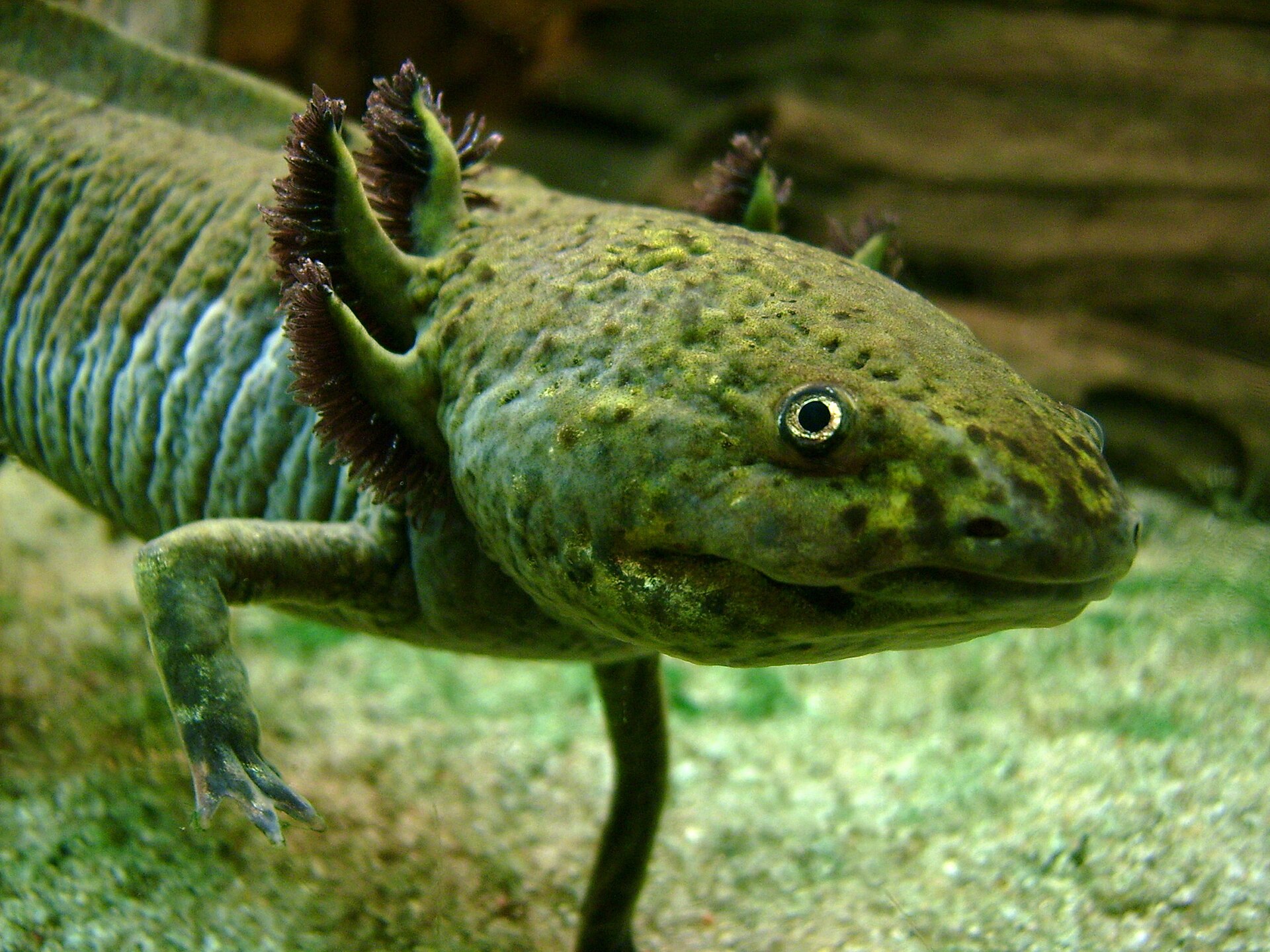
This salamander regrows its brain. Lose a limb, and the axolotl grows it back. Damage its jaw, its heart, even part of its brain — it regrows those too, with zero scarring. And it does all of it without ever growing up: the axolotl spends its whole life in its juvenile form, feathery gills and all. It is the most studied salamander on Earth, and in the wild it is nearly gone.
Watch the investigation
The Axolotl Short — "This Salamander Regrows Its BRAIN?!" — is live on the channel.
Watch on YouTubeThe regrowth record
Regrowing a toe is impressive. The axolotl's list is absurd: lost limbs, the jaw, heart tissue, tissues of the eye — even non-vital parts of the brain — all rebuilt, all without a scar. Scientists keep axolotls in laboratories all over the world for exactly this reason: if any animal holds the instruction manual for regeneration, it's this one, written in a salamander that never leaves the water.
Key facts — Case File #019
- The animal: the axolotl (Ambystoma mexicanum).
- The regrowth list: limbs, tail, jaw, heart tissue, eye tissue — even part of the brain — with zero scarring.
- The eternal childhood: neoteny — adults stay fully aquatic with external gills; they never grow up.
- The home: Lake Xochimilco and Chalco, Mexico City.
- The wild count: critically endangered — an estimated 50 to 1,000 left in the wild.
Never growing up
Most salamanders transform: gills out, lungs in, life on land. The axolotl skipped the meeting. It keeps its feathery external gills, stays in the water, and breeds in its juvenile body — a condition called neoteny. Peter Pan, with a genome scientists can't stop reading.
Famous everywhere, vanishing at home
Here's the hard turn in this case file. The axolotl is one of the most recognizable animals on the planet — in aquariums, laboratories, and book covers (including Wren's own Field Guide) — while its actual home, the lake system of Xochimilco in Mexico City, has shrunk around it. The wild population is estimated at just 50 to 1,000 animals. The salamander that can regrow almost anything cannot regrow its lake.
Frequently asked questions
What can an axolotl regrow?
Limbs, its tail and jaw, heart tissue, tissues of the eye, and even non-vital parts of its brain — regrown without scarring. It's the most complete regeneration of any vertebrate kept in laboratories.
Why does an axolotl keep its gills as an adult?
Neoteny: the axolotl never undergoes the usual salamander transformation. Adults stay aquatic and keep their feathery external gills for life.
How many axolotls are left in the wild?
Very few — the wild population in its home lakes at Xochimilco, Mexico City, is estimated at only 50 to 1,000, and the species is critically endangered.