
Why is this lizard's tongue faster than a sports car? The panther chameleon of Madagascar stacks three superpowers into one animal: eyes that swivel independently and look two ways at once, colors that talk instead of hiding — and a tongue that launches from 0 to 60 mph in a hundredth of a second. Blink, and you missed it.
Watch the investigation
The Panther Chameleon Short — "Why Is This Tongue Faster Than a Sports Car?!" — is live on the channel.
Watch on YouTubeNumber one: the eyes
Start with the turrets. Each of the chameleon's eyes sits on its own little tower and swivels completely independently of the other. That means a panther chameleon can look forwards and backwards at the same time — one eye watching for lunch, the other watching for anything that wants it for lunch. Add the two together and the chameleon gets near-360-degree vision without ever turning its head. It's a full-circle security system, built in.
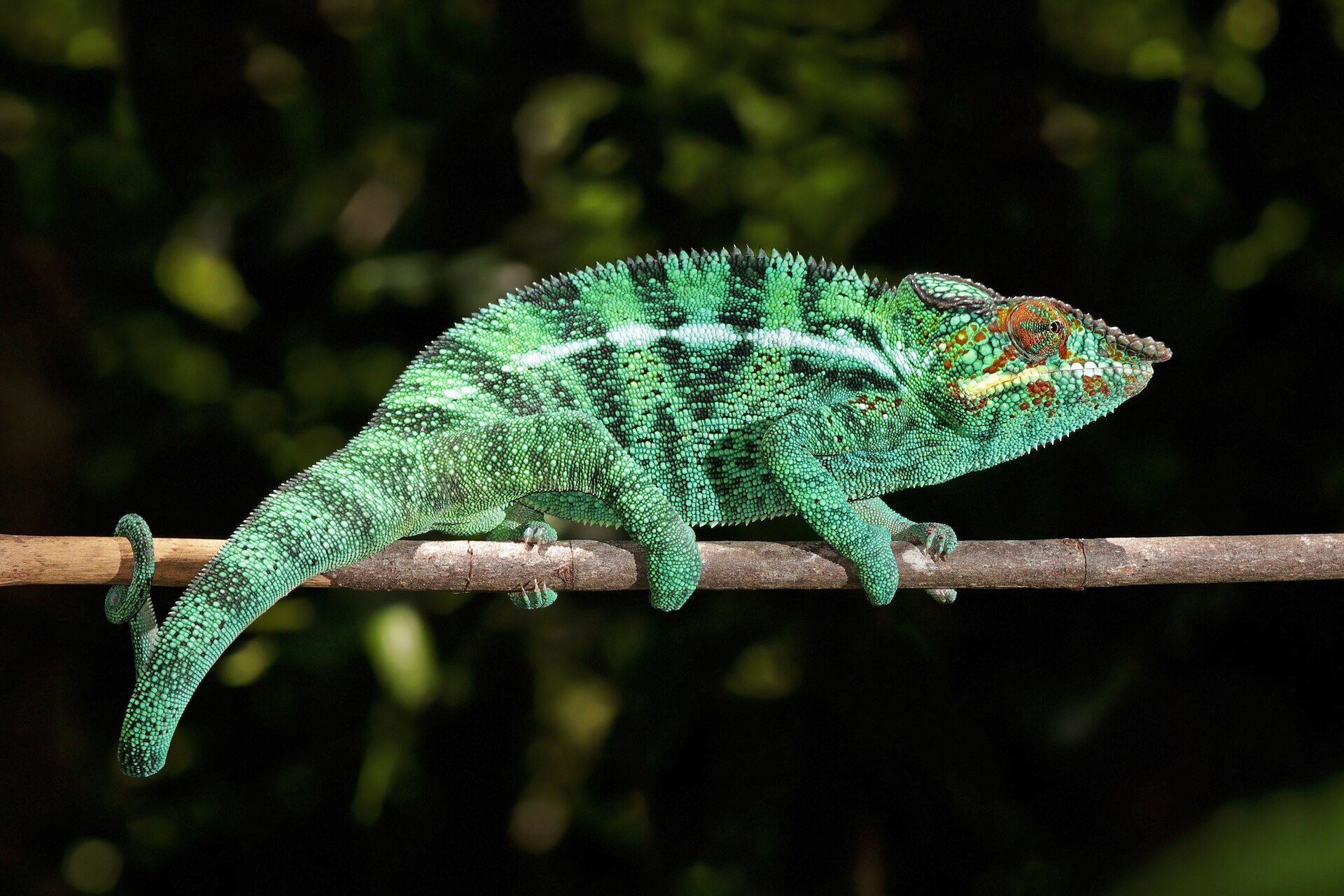
Key facts — Case File #043
- The animal: the panther chameleon (Furcifer pardalis), from Madagascar.
- The eyes: each eye moves independently on its own turret — forwards and backwards at once, near-360° vision.
- The colors: primarily communication (mood and social signals) and temperature control — not mainly camouflage. Bright means excited.
- The tongue: up to about twice the chameleon's body length, folded in the mouth like an accordion.
- The launch: 0 to 60 mph in 1/100th of a second, peaking at ~264× gravity — the highest acceleration recorded for any reptile, bird, or mammal.
Number two: the colors are talking
Here's the twist everyone gets wrong. The famous color change is not mainly camouflage. Researchers studying panther chameleons (Teyssier and colleagues, 2015) showed the change is driven by tiny photonic crystals in the skin — and its main job is communication: mood and social signalling, with temperature regulation on the side. When a male lights up bright, he's not disappearing. He's announcing himself. Bright means excited — the colors are a conversation, held in plain sight.
Number three: the tongue
And then there's the closer. A chameleon's tongue can reach about twice its body length, and it waits in the mouth folded up like an accordion. When it fires, it doesn't creep — it launches. Anderson's 2016 measurements put the projection at 0 to 60 mph in one hundredth of a second, with peak acceleration around 2,590 metres per second squared: 264 times the force of gravity, the highest of any reptile, bird, or mammal on record. One honesty note from the case file: that record was measured in small chameleon species — but the launch machinery is the family's shared design, and the panther chameleon runs the same system. The strike is over before a fly can react. Blink — and you missed it.
Frequently asked questions
How fast is a chameleon's tongue?
0 to 60 mph in one hundredth of a second, peaking at ~264× gravity — the highest acceleration recorded for any reptile, bird, or mammal. (The record comes from small chameleon species; the whole family shares the same launch design.)
Why do panther chameleons change color?
Mostly to talk. Color change is primarily communication — mood and social signals — plus temperature regulation. Bright means excited; it's a message, not a disguise.
Can a chameleon look in two directions at once?
Yes — each eye swivels independently on its own turret, so it can look forwards and backwards simultaneously, with near-360-degree vision.
Keep exploring
- 🦎 Mantis Shrimp: The Punch That Boils Water — another animal built around one impossible weapon
- 🦉 Eastern Screech Owl: Spot the Owl — a master of actual camouflage, for contrast
- 🦩 10 Rare Animals You've Never Heard Of — the field-guide list