
Can you spot the owl? There is one in this case file's opening photograph — sitting in the open, in daylight, exactly where a predator would want to find it. Most people scroll straight past. The eastern screech owl is a master of disguise: its feathers match tree bark so closely that a hollow in a trunk becomes an invisibility cloak. It naps there all day, in plain sight. Then the light goes, the eyes open, and the hide-and-seek champion goes hunting.
Watch the investigation
The Screech Owl Short — "Can You Spot the Owl?!" — is live on the channel. Watch the hollow closely.
Watch on YouTubeBark with eyes
The camouflage is the whole case. A screech owl's plumage carries the same greys, browns, and streaks as the bark of the trees it roosts in — not approximately, but closely enough that the bird's outline dissolves into the trunk. Tucked into a hollow or sitting lengthwise along a branch, eyes narrowed to slits, it becomes a knot in the wood. Birds that hunt it by day mostly never find it. People walk underneath it all the time. The disguise works because it isn't hiding the owl somewhere else — it's hiding the owl in the pattern of the tree itself.
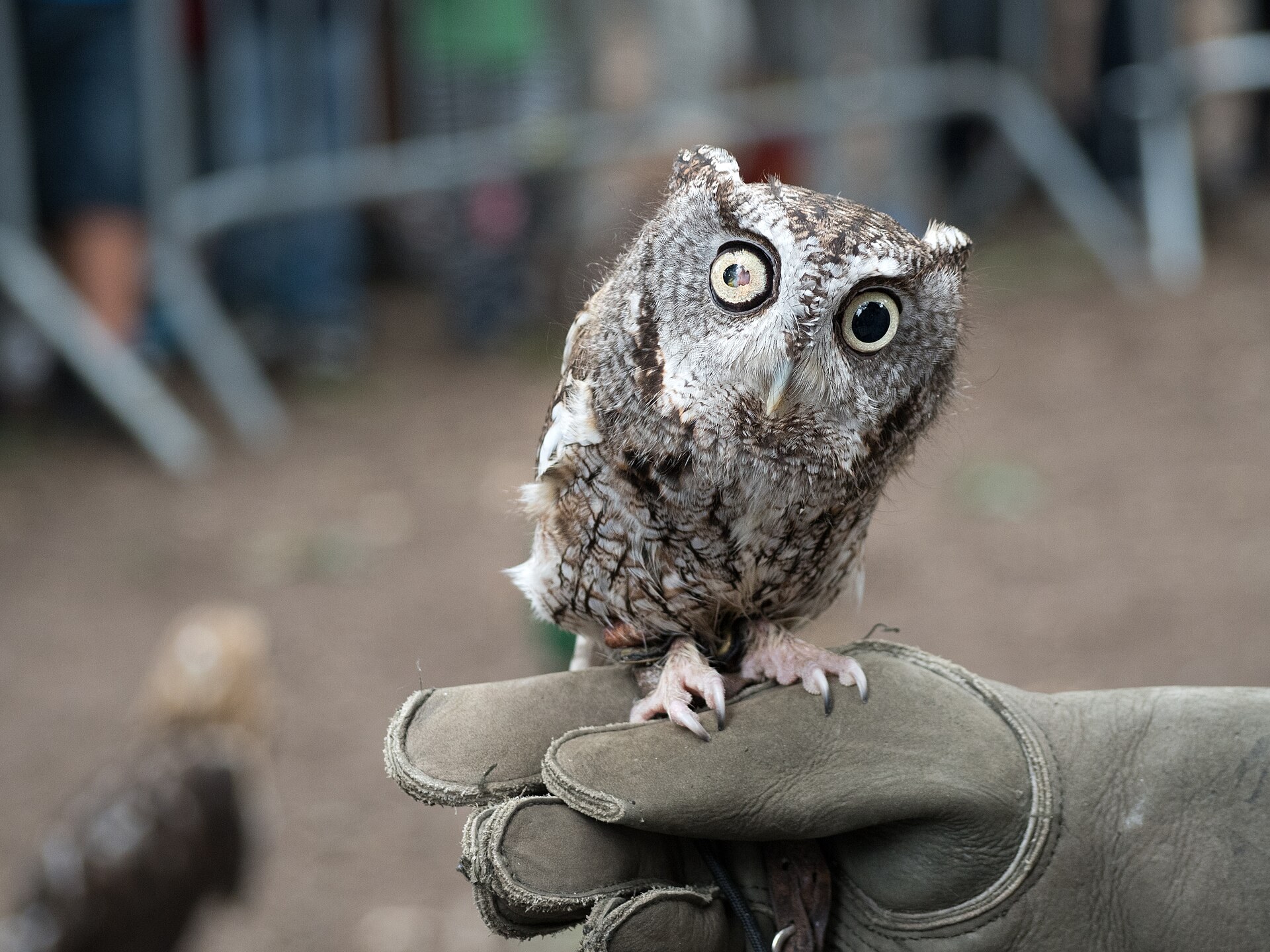
Key facts — Case File #033
- The animal: the eastern screech owl (Megascops asio), a small owl of North American woodlands.
- The disguise: feathers patterned to match tree bark — the owl vanishes against a trunk or inside a hollow.
- The routine: sleeps the day away in tree hollows, in plain sight, then hunts at night.
- The head: swivels about 270 degrees — three-quarters of a full turn.
- The title: nature's hide-and-seek champion, and this case file's favourite spot-it challenge.
A head on a swivel
When the owl does need to look around, it brings equipment. Like other owls, its eyes are fixed in their sockets — they can't glance sideways the way yours do. The compensation is famous: the head turns about 270 degrees, three-quarters of a full circle, letting the bird scan nearly everything around it without moving its body an inch. For an animal whose survival depends on not being noticed, that's the perfect tool — all of the looking, none of the movement.
So the next time you're under the trees in the middle of the day, spare a look for the hollows and the rough-barked trunks. There may be an owl up there, watching you not see it. That's not a failure on your part. That's the whole design.
Frequently asked questions
Why is the eastern screech owl so hard to spot?
Its feathers are patterned almost exactly like tree bark, and it spends the day tucked into a tree hollow or pressed against a trunk. Sit still, match the bark, close your eyes to slits — and an owl in plain sight simply disappears.
How far can a screech owl turn its head?
About 270 degrees — three-quarters of a full circle. An owl's eyes are fixed in their sockets, so the whole head does the looking instead.
Where does an eastern screech owl sleep?
In tree hollows and cavities, right out in the open woodland. The camouflage is so complete that the owl can sleep the day away in a spot people walk past without ever seeing it — then emerge at dark to hunt.
Keep exploring
- 🐱 Serval: The Cat That Hears Dinner Underground — another hunter built around one superpower sense
- ❄️ Winter Wildlife Watching: A Field Guide — owls and other cold-season spotting
- 🐦 Backyard Birds Field Guide: 5 Birds to Know