
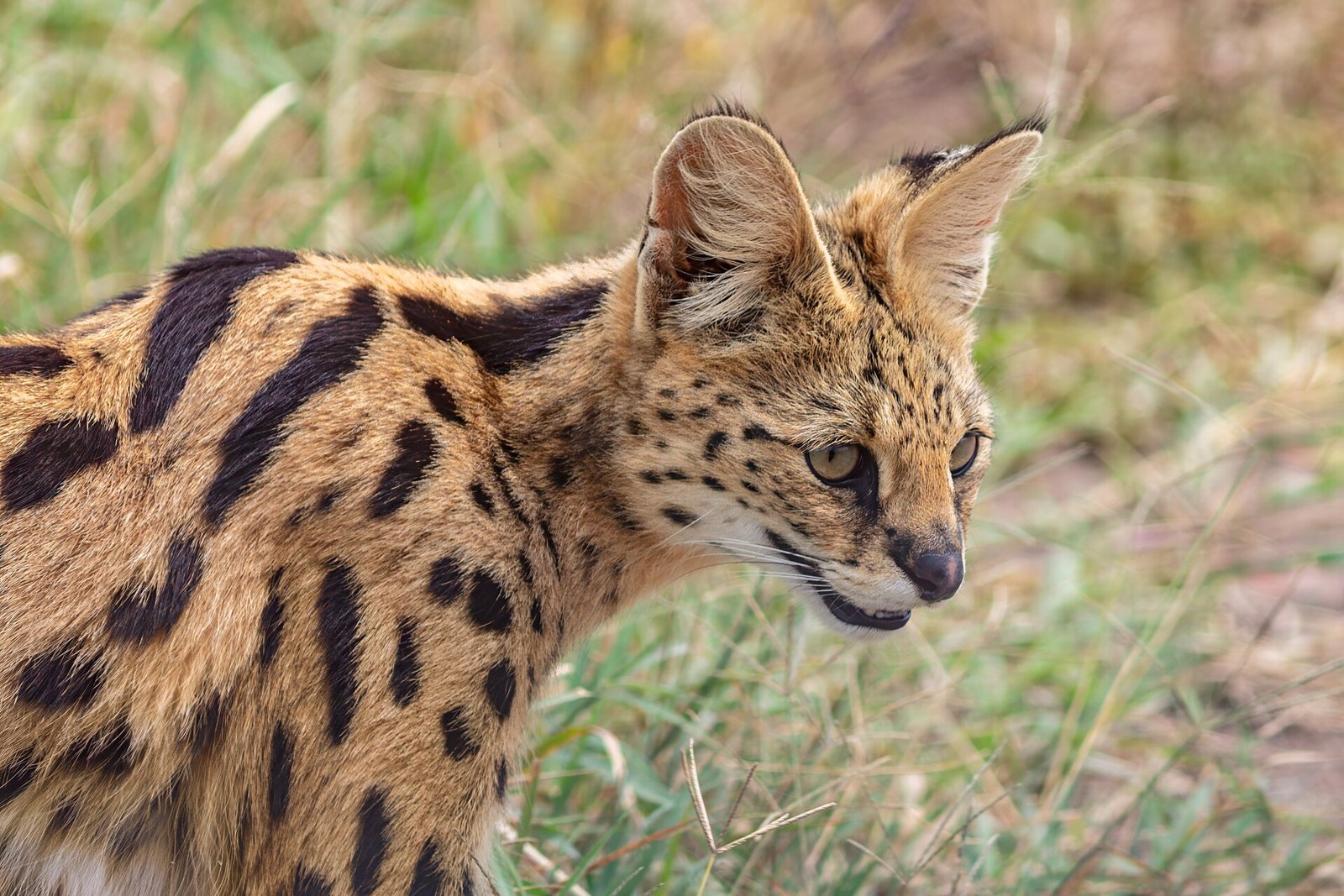
This cat hears its dinner underground. The serval stalks the grasslands of Africa on the longest legs in the cat family, carrying a pair of satellite-dish ears with twenty-two muscles each — ears sensitive enough to pick out a mouse moving beneath the dirt. When the ears lock on, the serval does something no other cat does quite the same way: it leaps nine feet straight up and comes down on dinner. And here's the closing number: half of every pounce ends in a kill.
Watch the investigation
The Serval Short — "This Cat Hears Dinner UNDERGROUND?!" — is live on the channel, and this one's special: the footage was filmed in the field by the man behind the camera at Wren HQ.
Watch on YouTubeSatellite dishes with 22 muscles each
Everything about the serval's hunt starts at the top of its head. Those ears are enormous for a cat its size, and each one is independently steerable — twenty-two muscles per ear, swivelling the dish toward sound the way you'd aim an antenna. Under the grass, under the surface of the soil itself, rodents move — and the serval can hear them doing it. It hunts prey it cannot see, triangulating dinner by ear, waiting for the exact moment the sound lines up under its paws.
Key facts — Case File #030
- The animal: the serval (Leptailurus serval), a wild cat of Africa's grasslands.
- The ears: 22 muscles in each ear; hearing fine enough to detect a mouse moving underground.
- The leap: up to 9 feet straight up from the ground.
- The record: about half of every pounce ends in a kill — elite numbers for a wild cat.
- The method: listen, lock on, launch — hunting by sound, not sight.
Nine feet straight up
When the ears say "there," the legs answer. A serval can jump about nine feet vertically — high enough to snatch birds out of the air as they take off, and high enough to drop straight down onto a rodent it heard but never saw. Height is accuracy: coming down from directly above, the serval lands on the exact patch of ground its ears mapped. Then the paws pin, and dinner is done.
Put the numbers together and this mid-sized cat quietly out-hunts the famous ones. Roughly one pounce in two succeeds. Most big cats would take those odds in a heartbeat. The serval gets them with a pair of ears, a spring-loaded spine, and patience — standing in the grass, listening to the ground, waiting for lunch to make a sound.
Frequently asked questions
How good is a serval's hearing?
Good enough to hunt by sound alone. Each of the serval's oversized ears is worked by 22 muscles, swivelling like a satellite dish — and the hearing behind them can pick up a rodent moving underneath the dirt.
How high can a serval jump?
About nine feet straight up from a standstill. The serval listens, locks on, and launches vertically — which also makes it a genuine threat to birds taking off.
How often does a serval catch what it pounces on?
About half the time. A success rate near 50% puts the serval among the most efficient hunters of all the wild cats — most big cats succeed far less often.
Keep exploring
- 🦉 Eastern Screech Owl: Can You Spot the Owl? — the other hunter you have to find before it finds dinner
- 🐻 Sun Bear: The Smallest Bear With the Longest Tongue
- 🦩 10 Rare Animals You've Never Heard Of — the field-guide list