
Two miles down, where no sunlight has ever reached, a camera found a ghost: a pale squid hanging motionless in the black water, trailing arms so long and thin they look like threads of spider silk. It is one of the least-seen large animals on Earth. This is the bigfin squid file.
A dozen sightings, ever
Bigfin squid (family Magnapinnidae) are among the great blanks on the map of animal life. As NOAA Ocean Exploration puts it, while bigfin squid are distributed throughout the world's deep ocean, only roughly a dozen sightings have ever been confirmed. Most of what science knows comes from juveniles caught in nets — the adults live too deep, across too much darkness, for anything but luck and a very patient submersible to find.
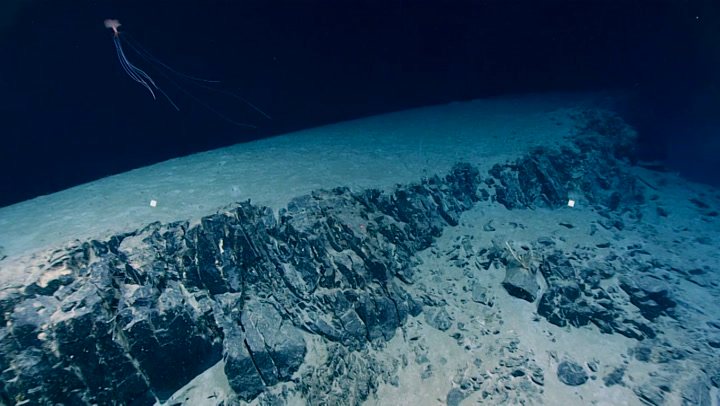
Key facts — the bigfin file
- The name: "bigfin" for its disproportionately large fins, which it ripples to swim and hold position.
- The arms: arms and tentacles of near-equal length trail into hair-thin filaments — held out with a strange bend, like elbows, with the threads hanging straight down.
- The depth: confirmed encounters start below ~1,000 m; one individual was filmed below 6,000 m — the deepest squid record known.
- The record: about a dozen confirmed sightings worldwide, across every ocean basin.
- The newest chapter: in September 2026, researchers with MBARI announced another live sighting — this one in the northeastern Pacific.
Built like nothing else down there
No other squid is shaped like this. A bigfin's arms don't taper into clubs the way a familiar squid's do — they extend into filaments many times the body length, and the animal holds them out from distinctive bent joints, letting the threads dangle into the current. Scientists suspect the threads work like a living drift net: anything small that bumps into one sticks, and the arm slowly reels it in. It is a fishing strategy made of patience and darkness — and it may explain how an animal can afford to be this rare and this slow in the largest habitat on the planet.
Why we know so little
The deep ocean is the biggest living space on Earth and the least visited. A bigfin squid can drift for years in water no vehicle ever crosses. Each confirmed sighting — a few seconds of ROV video, usually — rewrites something: the 2021 NOAA footage in this file showed an adult in the Atlantic; a bigfin filmed off Australia in 2020 was the first ever recorded in that country's waters; the Philippine Trench individual reset the depth record for all squid. In September 2026 the list grew again, when MBARI researchers announced a live bigfin encounter in the northeastern Pacific. A dozen-ish data points, total, for an animal that may be eight metres long. The file on this species is mostly empty pages — and that's exactly what makes it a Wren case.
Somewhere below the light, right now, one of these is hanging in the current with its threads out, waiting for something to touch them. We will almost certainly never see it. Keep looking closer anyway.
Frequently asked questions
How big is a bigfin squid?
Most of a bigfin is arm. Its mantle (body) is modest, but its arms and tentacles trail into extremely long, thin filaments — total length estimates reach toward 8 metres (about 26 feet) in the largest filmed individuals, though few adults have ever been measured directly.
How many times has a bigfin squid been seen?
Only about a dozen sightings have been confirmed worldwide. Almost everything known about the family comes from a handful of submersible and ROV encounters plus juvenile specimens — which is why every new sighting makes news.
Where do bigfin squid live?
In the deep ocean worldwide, far below sunlight — most confirmed encounters are deeper than 1,000 metres, and one bigfin was filmed more than 6,000 metres down, the deepest any squid has ever been recorded.
Keep exploring
- 🦐 Case File #009: The Mantis Shrimp — the punch that boils water
- 🐧 The Penguin That Was Secretly Four Penguins — a species hiding in plain sight
- 🌊 10 Rare Animals You've Never Heard Of — more of the planet's best-kept secrets