
Six thousand years before the Great Pyramid, before farming, before the wheel — somebody in what is now southeastern Turkey carved pillars taller than a giraffe, stood them in circles, covered them with animals… and then buried the whole thing on purpose. First, the verified archaeology. Then, clearly labeled, the speculation. That's the order in every ancient-mysteries case file.
Watch the investigation
The Göbekli Tepe Short — "This Temple Is 11,000 Years Old" — opens this case file on the channel.
Watch on YouTubeOlder than it should be
Göbekli Tepe sits on a hilltop near Şanlıurfa, in southeastern Turkey. Its oldest stone enclosures date to around 9500 BCE — about 11,500 years ago. To feel that number: Stonehenge is roughly 6,000 years younger. The Great Pyramid is younger still. When the first circle at Göbekli Tepe was raised, the region had no farms, no pottery, no metal, and no wheel. The standard story of civilization says monuments come after all of that. This one came first.
Pillars with a zoo carved into them
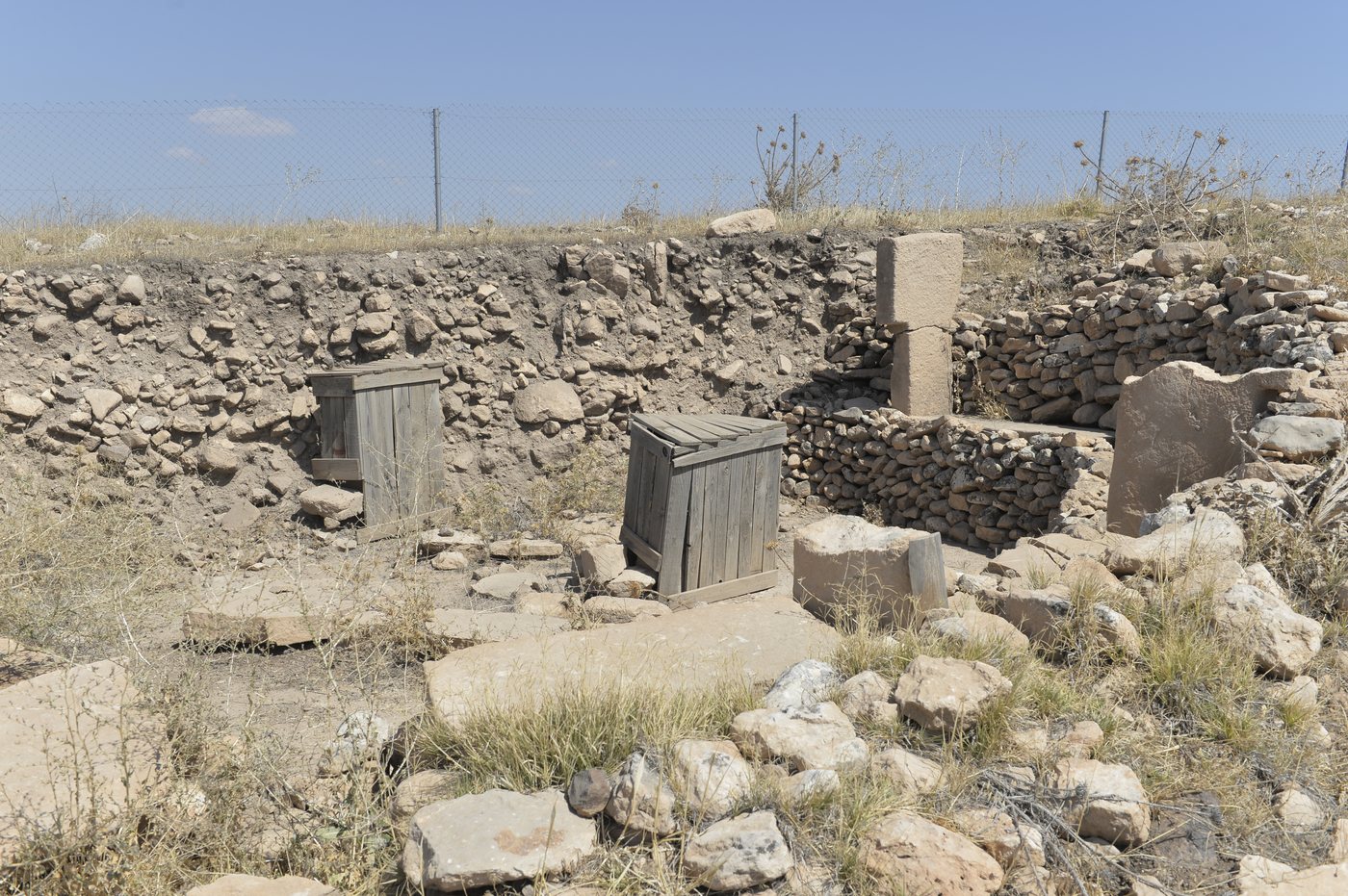
The enclosures are rings of T-shaped limestone pillars, some standing about 5.5 meters tall and weighing many tonnes each. And they are carved — foxes, wild boars, cranes, snakes, scorpions, lions, and abstract symbols cover the stone. The central pillars of some circles even carry carved arms and belts, as if the T-shapes were stylized people. Whoever made this place was running a full artistic tradition, in stone, at monumental scale, at the very start of the Neolithic.
Key facts — Case File #026
- Age: earliest enclosures ~9500 BCE — about 11,500 years old, ~6,000 years before the Great Pyramid.
- The builders: hunter-gatherers of the Pre-Pottery Neolithic — no farms, no metal, no wheel.
- The pillars: T-shaped limestone monoliths up to ~5.5 m tall, carved with animal reliefs.
- The excavator: recognized by archaeologist Klaus Schmidt, who began excavations in 1995 after a 1994 survey.
- The burial: around 8000 BCE the enclosures were deliberately backfilled — the act that preserved the carvings for us.
- The scale: only a fraction of the site has been excavated; geophysical surveys show many more enclosures still underground.
The burial is the mystery inside the mystery
Here is the part that keeps investigators up at night. Göbekli Tepe was not destroyed by an enemy or swallowed by an earthquake. Around 8000 BCE, its enclosures were carefully filled in — buried under tonnes of rubble, flint tools, and animal bones. That burial is the only reason the carvings survive in such condition. So the same culture that spent generations raising the pillars later spent enormous effort putting them to sleep. Why? A ritual closing? Protection from something? The honest answer is that nobody knows.
The Fringe File — labeled speculation
Everything in this section is speculation, labeled as such. The site's age has attracted bigger claims: that it was an astronomical observatory aligned to specific stars, that its carvings record a comet strike, or that it proves a lost advanced civilization taught the builders. These ideas go beyond what the archaeology can currently support — the carvings are real, the alignments and catastrophe readings are contested interpretations, not findings. The verified half of this file is strange enough on its own: hunter-gatherers built the world's oldest known monumental temple complex, and it rewrites the order of the story — first the monument, then, perhaps because of gatherings like this one, the farming that followed. The temple may have come before the bread.
The case stays open
Most of Göbekli Tepe is still in the ground. Every season of excavation adds pillars, carvings, and questions. A temple older than agriculture, built by people we once assumed couldn't build it, buried by hand for reasons nobody has recovered — that's not a gap in the story. That is the story.
Frequently asked questions
How old is Göbekli Tepe?
About 11,500 years old. Its earliest enclosures were built around 9500 BCE — roughly 6,000 years before the Great Pyramid and long before farming, pottery, or the wheel in the region.
Who built Göbekli Tepe?
Hunter-gatherers. The site holds no evidence of a settled farming town from its earliest phase — the builders appear to have been Stone Age foragers who organized, carved, and raised multi-tonne pillars without metal tools or wheeled transport.
Why was Göbekli Tepe buried?
Nobody knows. Around 8000 BCE the enclosures were deliberately backfilled with rubble and debris, which is what preserved the carvings. Whether it was ritual closure, protection, or something else entirely remains an open question.
Keep exploring
- 🌀 The Lost Labyrinth of Egypt — 3,000 rooms, still missing
- 🗿 Case File #060: Baalbek — the 800-ton stones nobody can explain
- 🏛️ Giants of the Ancient World — the city, the measurement, and the stones