
The Lost Labyrinth of Egypt: a 3,000-room building at Hawara that Herodotus said surpassed the pyramids — and a lower half no one has been allowed to enter for over 2,000 years. This is the field note behind Wren's full investigation: the ancient witnesses who walked it, the platform Flinders Petrie uncovered, the 2008 expedition scans that reported walls and chambers under the sand — results never fully published — and the water now rising beneath it all.
Watch the investigation
The full film — The Lost Labyrinth of Egypt: 3,000 Rooms Still Missing — premiered on the Explore With Wren channel on Saturday, October 17, 2026. Watch it now on YouTube.
Watch on YouTubeThree ancient witnesses
Herodotus, writing in the 5th century BCE, said he walked the Labyrinth's upper halls himself — and that it surpassed the pyramids. His count: 3,000 chambers, 1,500 above ground and 1,500 below. The lower halls, he was told, held the tombs of kings and the shrines of sacred crocodiles — and they were closed to him. Strabo, centuries later, called the building a work quite equal to the pyramids, its courts roofed with single stones. Pliny retold it for the Roman world: passages doubling back on themselves, doors that trick you onward and force you to retrace your own steps. Three writers, one impossible building — and then, silence. The Labyrinth vanished from the record.
Key facts — the Labyrinth file
- The witness: Herodotus (5th c. BCE) described 3,000 chambers — 1,500 above, 1,500 below.
- The site: the Hawara complex of Amenemhat III, ~90–100 km southwest of Cairo, is identified as the Labyrinth's location.
- The footprint: Petrie (1888) found a levelled platform ~1,000 × 800 ft where the building stood.
- The scans: the 2008 Mataha Expedition reported walls and chambers under the sand; its results were never fully published.
- The threat: rising groundwater at Hawara endangers anything that survives below.
Eaten, not lost — Petrie digs
When Flinders Petrie excavated at Hawara in 1888, he found why the Labyrinth disappeared: it had been eaten. The great building was quarried away over centuries — its stone burned for lime and carried off — until what remained was the platform it stood on: a levelled foundation roughly 1,000 feet long by 800 feet wide, matching the footprint the ancient descriptions imply. The Labyrinth wasn't hidden. It was recycled. Whatever lay below ground, though, the lime kilns couldn't reach.
The 2008 scans: walls in the dark
In February and March 2008, the Mataha Expedition — a Belgian-Egyptian team working with Egypt's national geophysics institute and Ghent University — ran geophysical scans over the ground south of the pyramid. In the expedition's telling, the instruments reported exactly what the ancient writers would predict: walls, chambers, and a grid of structures under the sand. The results were presented in Ghent that autumn. And then — in the expedition's account — publication stalled, the full data never entered the scientific record, and the scans were never independently tested. That is where the claim honestly stands: readings reported by the people who made them, intriguing and unverified, waiting two decades for someone to dig.
The claim riding the wave — labeled
This claim is attributed and unverified. Researcher Louis de Cordier, who led the 2008 expedition, says in his recent interviews that Egypt confirmed fresh excavations at Hawara in 2026 and that digging is under way. As of this writing, no published excavation report confirms a new dig at Hawara, and no major news outlet or Egyptian ministry announcement has verified one. The claim traces back to the wave of videos itself. It may yet prove true — but in this file it rides at claim strength, not fact strength, and that's exactly how the film carries it too.
The real enemy is water
While the arguments run, the ground is changing. A peer-reviewed geophysical study of Hawara documents rising groundwater around the complex — water creeping up toward whatever survives below the platform. The lower half of the Labyrinth, if it exists, has waited 2,000 years sealed in dry darkness. Water is the one excavator that doesn't publish, doesn't ask permission, and doesn't stop. Herodotus was allowed upstairs and refused the lower 1,500 rooms. They have been closed to everyone since. The question is no longer only who gets to open them — it's whether anything is left when someone finally does.
Frequently asked questions
Where is the Lost Labyrinth of Egypt?
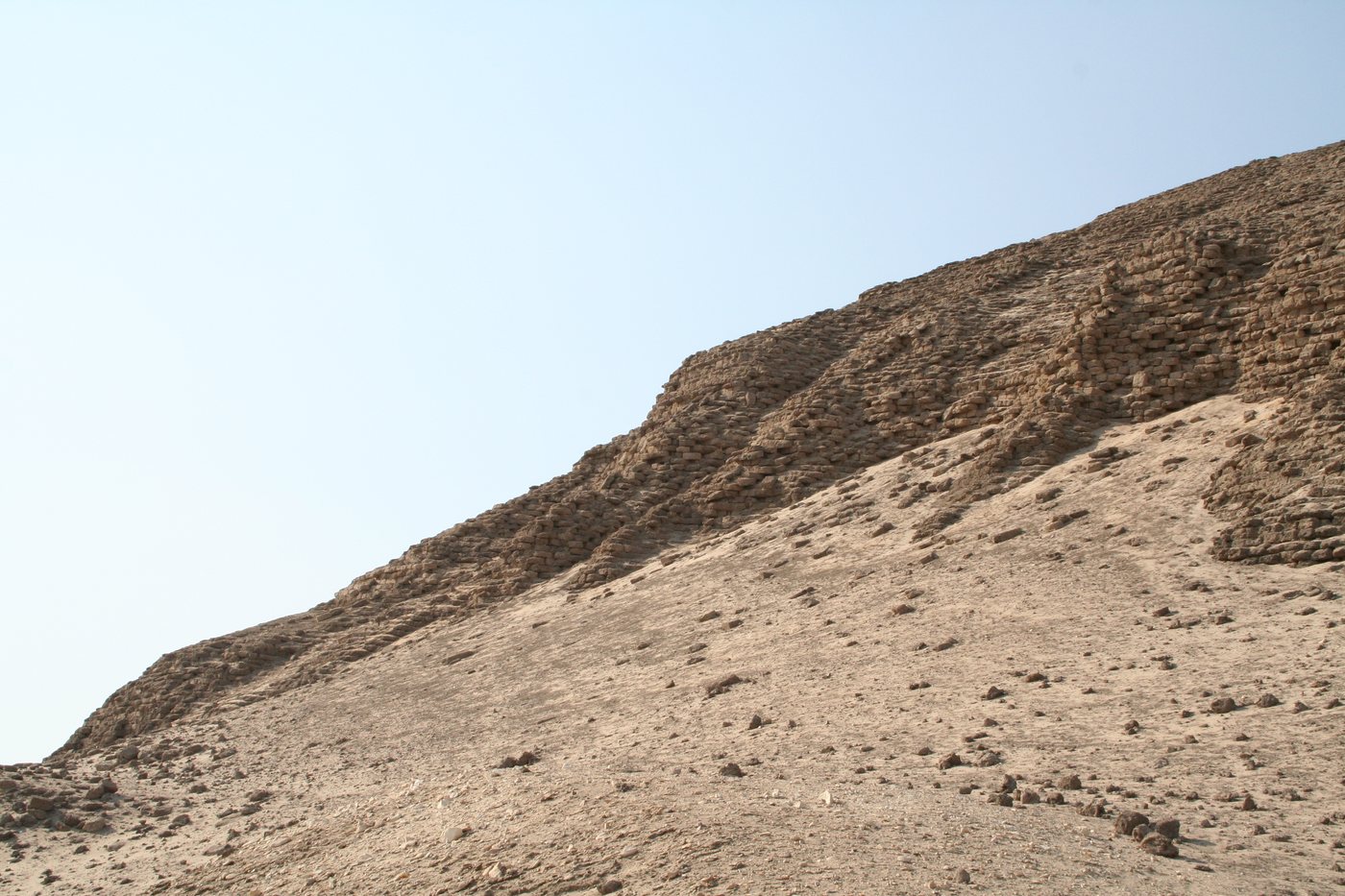
At Hawara, in Egypt's Faiyum region, roughly 90–100 kilometres southwest of Cairo, beside the pyramid of Amenemhat III. The Hawara complex of Amenemhat III is identified as the Labyrinth's site.
Has the Labyrinth been found?
Partly. In 1888, Flinders Petrie uncovered a levelled platform about 1,000 by 800 feet where the building stood — the footprint of the Labyrinth. The famous lower level described by ancient writers has never been excavated.
What did the 2008 Mataha Expedition find?
The expedition's geophysical scans at Hawara reported walls and chambers beneath the sand. Those results were never fully published for other scientists to test, so the claims rest at expedition strength — intriguing readings, not settled findings.
Keep exploring
- 🗿 Case File #060: Baalbek — the 800-ton stones nobody can explain
- 🏺 Case File #026: Göbekli Tepe — the temple buried on purpose
- 🏛️ Giants of the Ancient World — the city, the measurement, and the stones