
A flash of red, black, and yellow in the leaf litter — is it one of the most venomous snakes in North America, or a harmless actor wearing its colors? For generations, explorers have answered that question with a little poem. The poem is good. It is not perfect. Here is the rhyme, exactly where it works, exactly where it breaks — and the field checks that hold up when the poem doesn't.
The rhyme
"Red touches yellow, kill a fellow.
Red touches black, friend of Jack."
On a coral snake, every red band sits against a yellow band. On its harmless mimics, the red bands sit against black. Learn it — then keep reading, because this poem has a passport problem.
Snake one: the eastern coral snake — the real thing
The eastern coral snake (Micrurus fulvius) is a small, slender, secretive snake of the southeastern United States — usually 20 to 30 inches long, glossy as polished glass, and almost never in a hurry. It spends most of its life under leaf litter and debris, hunting lizards and small snakes. Its venom is powerful, its fangs are small and fixed at the front of its mouth, and it would much rather leave than bite: nearly every bite on record happened when someone picked one up or pinned it down.
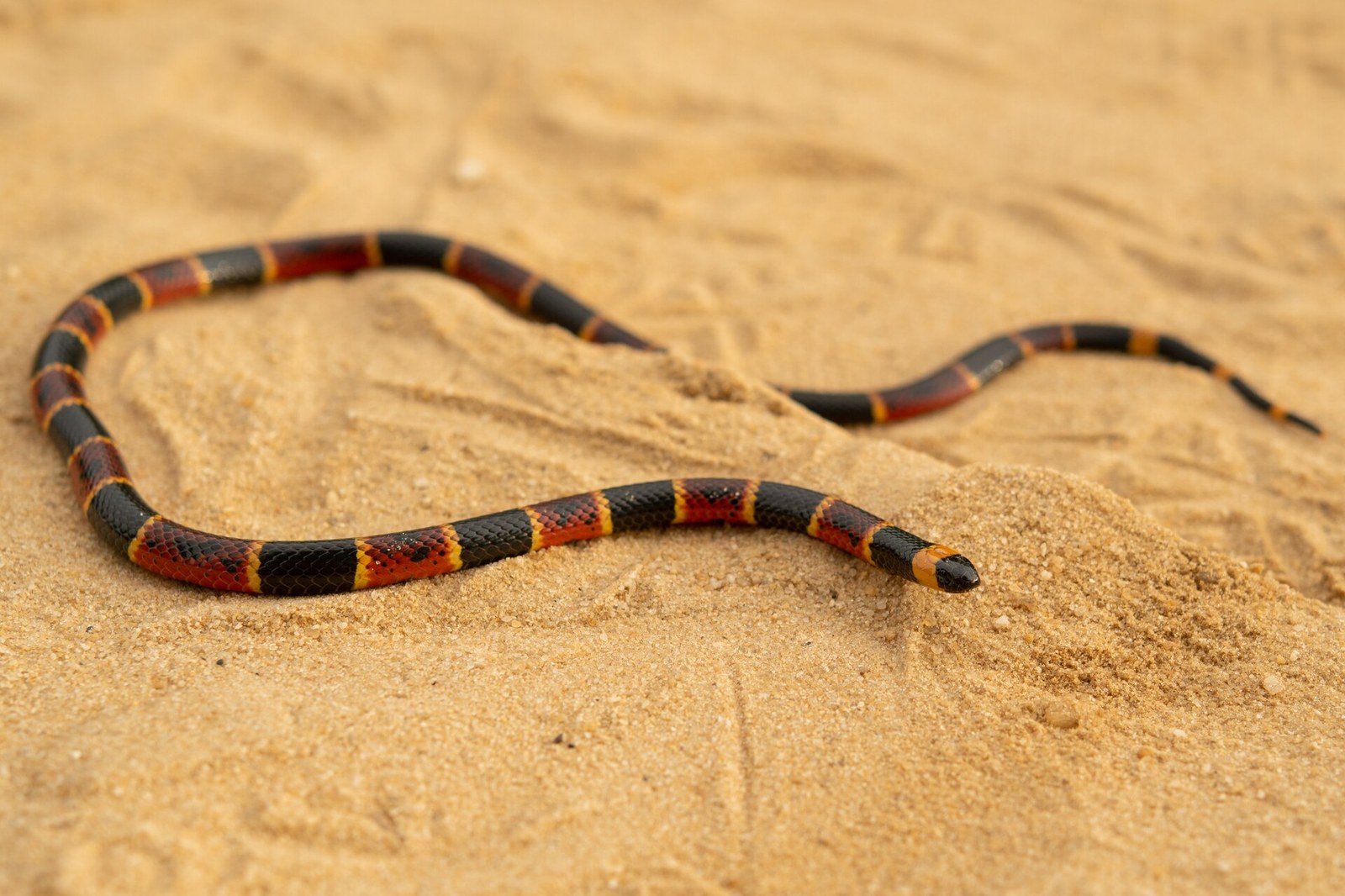
Three checks confirm a coral snake better than any poem. The rings go all the way around — red, black, and yellow bands circle the whole body, belly included. The snout is blunt and black, like it dipped its nose in ink, with a wide yellow band right behind the head. And the red bands are bordered by yellow, exactly as the rhyme says — while the tail carries black and yellow bands only, no red at all.
Key facts — the three-snake check
- Eastern coral snake (venomous): red touches yellow · rings wrap all the way around the body · blunt black snout · tail banded black and yellow only.
- Scarlet kingsnake (harmless mimic): red touches black · red, pointed snout · bands fade out on a pale, sometimes speckled or checked belly.
- Corn snake (harmless): no bands at all — large dark red blotches down the back · bold black-and-white checkerboard belly.
- The rhyme's range: a United States rule of thumb. It does not survive the trip into Central and South America.
- The rule that never breaks: never pick up a snake to check. Look, photograph from a distance, and let it go on its way.
Snake two: the scarlet kingsnake — the rhyme's true partner
The scarlet kingsnake (Lampropeltis elapsoides) is the snake the rhyme was written about. It wears the same red, black, and pale bands as the coral snake — but in the safe order: its red bands are bordered by black, never by yellow. This is one of nature's great bluffs, called Batesian mimicry: a completely harmless snake copying a dangerous one's warning colors so predators leave it alone. It works on hawks and raccoons. It works on people, too — which is exactly why the rhyme exists.
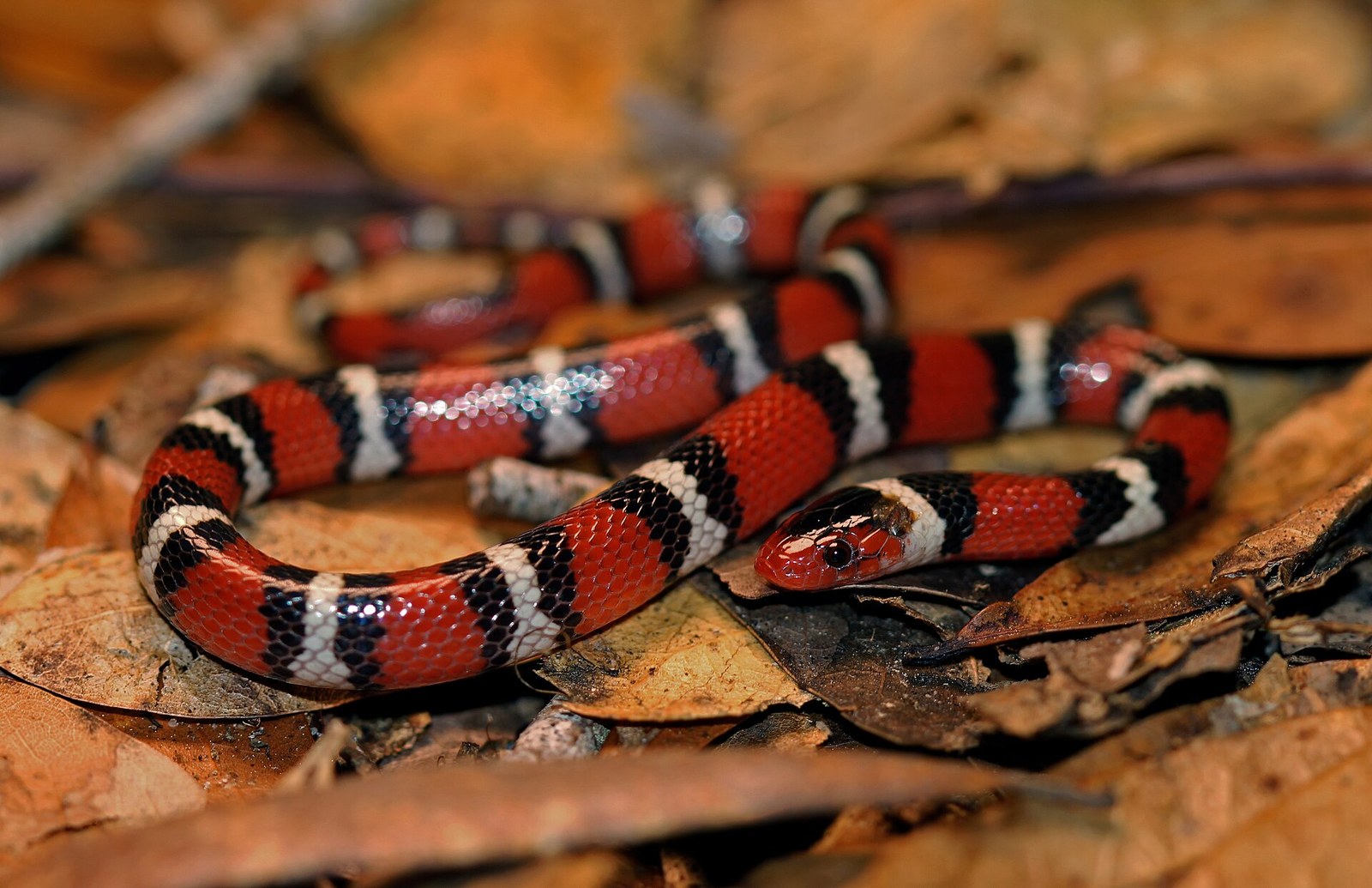
Beyond the rhyme, two more tells give the kingsnake away. Its snout is red and pointed — the coral snake's is black and blunt. And while a coral snake's rings wrap cleanly all the way around, the kingsnake's bands often fade out across a pale belly, sometimes leaving speckles or checks behind. Scarlet kingsnakes are small — most adults are 14 to 20 inches — shy, and harmless to people and pets. Their only crime is dressing like their dangerous neighbor.
Snake three: the corn snake — the glance look-alike
The corn snake (Pantherophis guttatus) confuses people at a glance — it's orange-red and patterned, and it turns up in exactly the same barns, gardens, and woodpiles. But look for one second longer and the confusion evaporates: a corn snake has no bands at all. It carries large, dark red blotches down its back, each one outlined in black, and if you ever see its underside (from a respectful distance, as it climbs away), it's a bold black-and-white checkerboard — a pattern that may be where the name comes from, since it resembles the kernels of variegated corn.
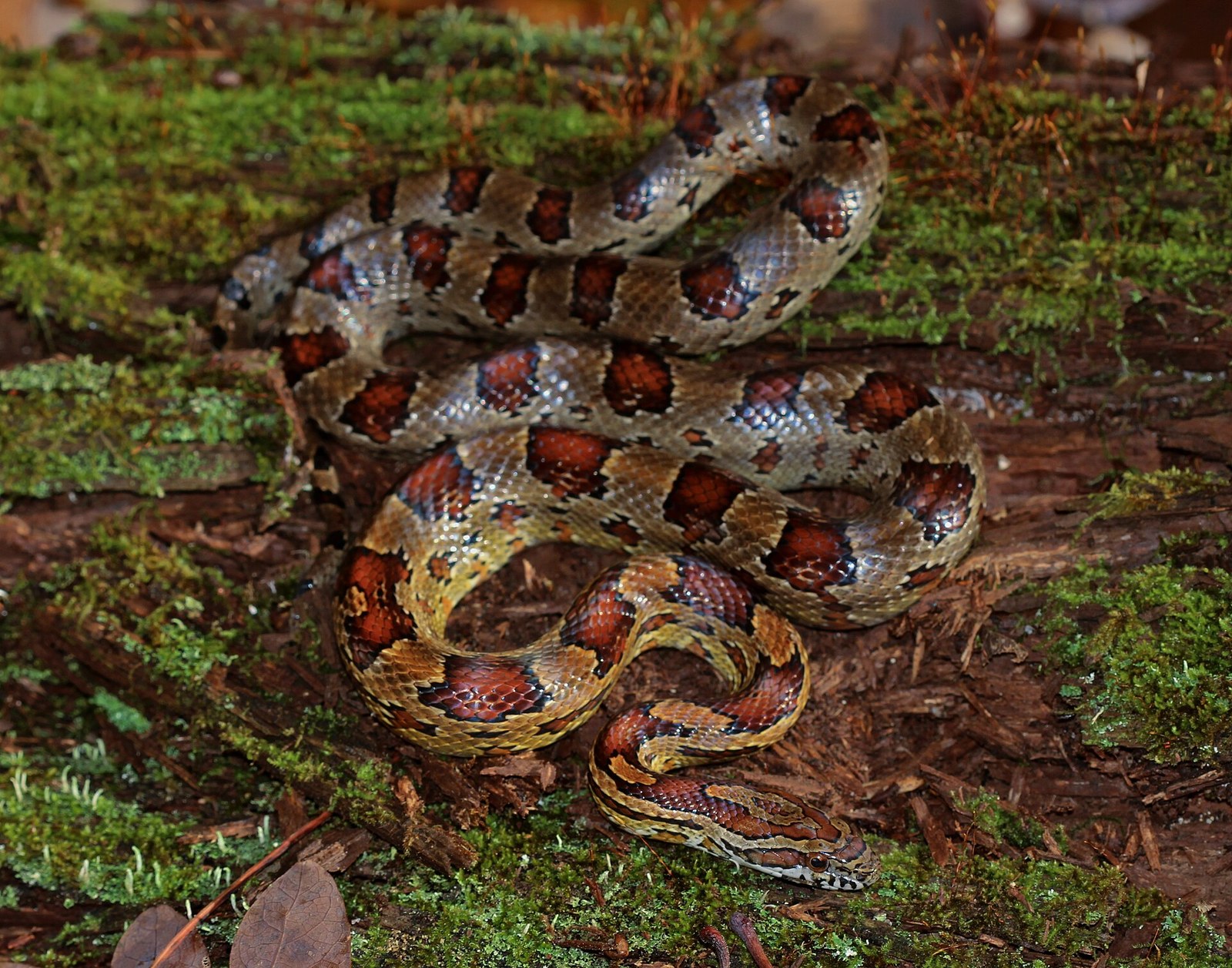
Corn snakes grow bigger than the other two — commonly 30 to 48 inches — and they earn their keep: a corn snake around a barn is a full-time rodent patrol. Harmless, calm, and useful. It only enters this guide because of its colors; its pattern was never really a disguise.
Where the rhyme breaks
Now the part that makes this guide honest. The rhyme is a United States rule of thumb — not a law of nature — and it fails in three ways every explorer should know.
It fails at the border. Coral snakes are a big, diverse family across the Americas, and south of the United States the pattern rules dissolve: many coral snake species in Mexico, Central America, and South America have red touching black. Some have no red at all — the red-tailed coral snake wears black and pale rings and not a drop of red. Use the poem in the tropics and it can point you exactly backwards.
It fails on the odd individual. Even inside the United States, rare coral snakes are born with unusual patterns — missing their yellow pigment, washed pale, or nearly all black. A poem can't read a pattern that isn't there. Out west, the Arizona coral snake's "yellow" bands can be so pale they read as cream or white at a glance.
And it fails under pressure. Most people meet a banded snake suddenly, at close range, with their heart pounding — the worst possible moment to recite poetry and squint at which color touches which. The rhyme is a fine first clue. It was never meant to be the whole investigation.
The rule that never breaks
So here is the landing, and it's the only rule in this guide with no exceptions: never pick up a snake to check what it is. Every check in this guide — the rhyme, the snout, the rings — can be done from a respectful distance, with your eyes or a phone camera's zoom. Admire it, photograph it, and let it slide on its way; it has somewhere to be, and so do you.
If a snake turns up inside the house, the garage, or the middle of the yard and won't move along, keep people and pets back and call local animal control or a licensed snake relocator — that's their whole job, and they're good at it. And if any snake ever does bite, treat it as an emergency and get medical care immediately, even if you think you know what it was.
One more thing, explorer to explorer: the look-alikes deserve the same respect as the real thing. Scarlet kingsnakes and corn snakes are harmless neighbors doing free pest control, and they get killed every year for wearing bright colors. Knowing the difference isn't just about keeping yourself safe — it's about keeping them alive. Education first. Then imagination. Then, always, a little mercy for the actor in the costume.
Identification facts in this guide were checked against the Florida Fish and Wildlife Conservation Commission's snake guide, the North Carolina Wildlife Resources Commission, and the Virginia Herpetological Society.
Frequently asked questions
Is the coral snake rhyme true?
As a rule of thumb for normally patterned snakes in the United States, yes: red touches yellow means coral snake, red touches black means a harmless mimic. But many coral snakes in Central and South America have red touching black, and rare odd-patterned US coral snakes break it too — so never use the rhyme as permission to touch a snake.
What is the fastest way to tell a coral snake from a scarlet kingsnake?
Check the snout and the bands. A coral snake has a blunt, black snout, red bands bordered by yellow, and colored rings that wrap all the way around its body. A scarlet kingsnake has a red, pointed snout and red bands bordered by black, and its pattern fades out on a pale belly.
Are corn snakes dangerous?
No. Corn snakes are harmless constrictors and welcome rodent hunters around barns and gardens. They are also not truly banded snakes: they carry large dark red blotches down the back and a bold black-and-white checkerboard belly.
Keep exploring
- 🦐 Case File #009: The Mantis Shrimp — the punch that boils water
- 🐙 Bigfin Squid: The Ghost With Arms Longer Than a Bus — a dozen sightings, ever
- 🐦 Backyard Birds Field Guide — more identification skills for your own yard