
One insect, three investigations. Dragonfly Facts is Wren's text-led series — no narration, just the cards and the evidence. Part 1 meets the last dragonfly still flying in November. Part 2 goes underwater, where a dragonfly spends years of its life as a jet-powered submarine. And Part 3 follows the Green Darner on a migration of more than 1,500 miles — a trip no single dragonfly ever finishes.
Watch the investigation
All three Dragonfly Facts episodes are live on the channel:
Part 1 — The last dragonfly of the year
November. Every other dragonfly is gone. The Autumn Meadowhawk is still flying — it owns the latest flight season of any dragonfly in its range, on the wing from late July into early November, and you can tell him by his yellow legs. The episode's last card is the whole animal in one line: he won't stop until the cold does.
Part 2 — The jet-powered submarine
Before it ever flies, a dragonfly lives underwater — some species stay down there for years. The nymph breathes through its rear end, where its gills are, and when it needs to move fast it fires that water out like a jet. The sky hunter starts life as a jet-powered submarine, and Part 2 films the emergence: the day the submarine climbs out and becomes the aircraft.
Key facts — the Dragonfly Facts series
- Part 1 — Autumn Meadowhawk: the last dragonfly of the year; flight season late July to early November, the latest of any dragonfly in Minnesota; told by his yellow legs.
- Part 2 — The Nymph: a dragonfly's underwater stage lasts from a few months to over five years by species; it breathes through gills in its rear — and jets water out of the same place to move.
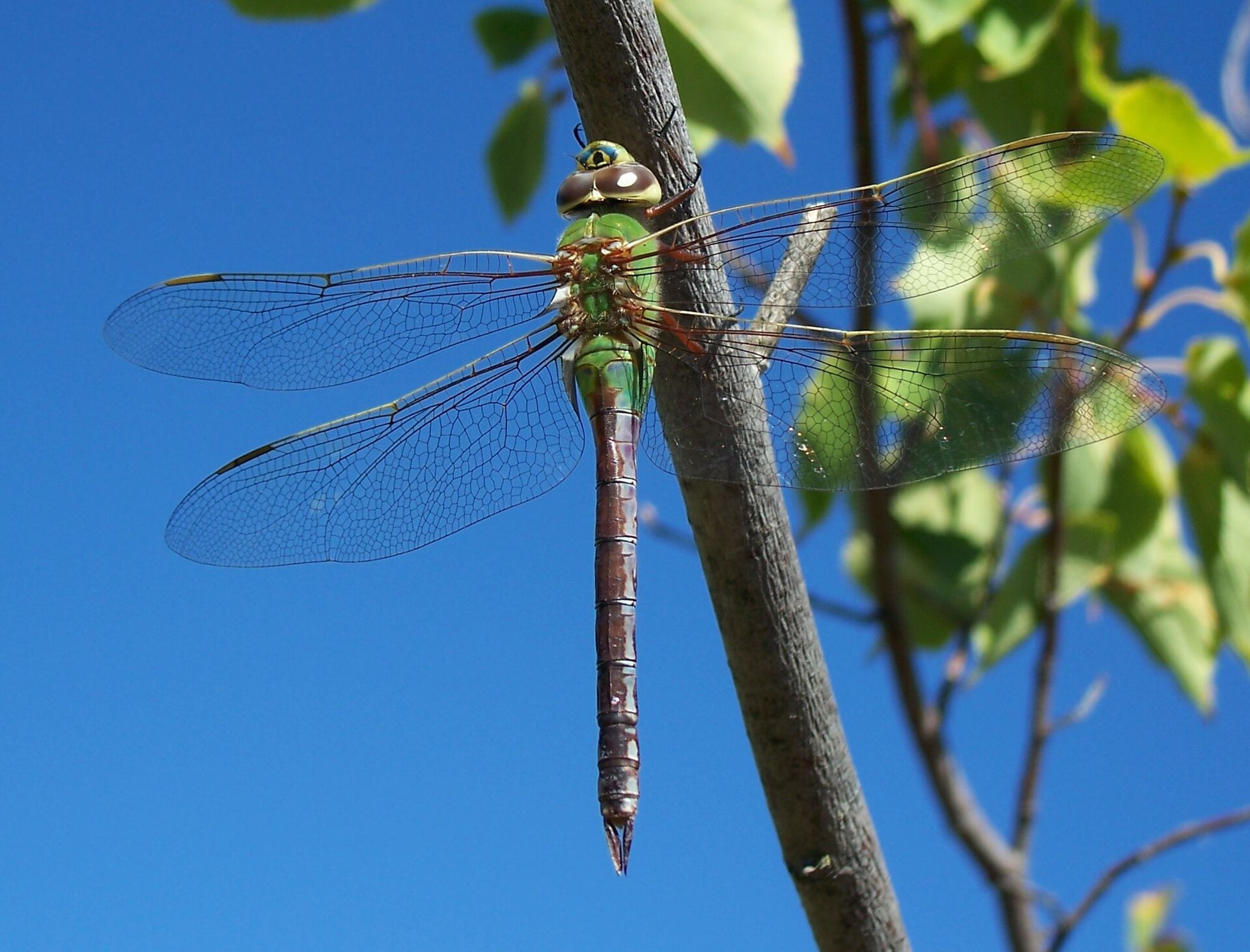
- Part 3 — Green Darner: wingspan about 3 inches (7.5 cm); migration legs run over 400 miles; some individuals fly over 1,500 miles (an isotope-based estimate from Hallworth et al. 2018).
- The relay: three generations hand the migration off — north, south, home. No single dragonfly ever finishes the trip.
Part 3 — The migration nobody knows
The green darner migrates like a monarch — and almost nobody knows. The journey runs on a relay: one generation emerges in the south and flies north to breed and die; the next flies south in the fall; a third, resident generation holds the south through winter and starts the cycle again. Each leg runs over 400 miles on 3-inch wings, and isotope studies of wing tissue show some individuals cover more than 1,500 miles in a lifetime. It is one of the great migrations on Earth, performed by an insect most people swat at.
Why a series?
Dragonflies earned the arc. A single episode couldn't hold the meadowhawk's stubborn autumn, the nymph's underwater years, and the darner's continental relay — three different animals wearing the same name. Parts 4 and 5 are already on the case board: a giant from 300 million years ago, and the most successful hunter on the planet.
Frequently asked questions
Which dragonfly flies latest into the year?
The Autumn Meadowhawk — Part 1 of the series. Its flight season runs from late July into early November, the latest of any dragonfly in Minnesota, and it can be identified by its yellow legs.
How long does a dragonfly live underwater?
The nymph stage lasts from a few months to more than five years depending on the species. The nymph breathes through gills in its rear end and can jet water out for propulsion — Part 2's jet-powered submarine.
Do dragonflies migrate?
Yes — the green darner runs one of the longest insect migrations known: a three-generation relay (north, south, home) with legs over 400 miles and some individuals flying over 1,500 miles. No single dragonfly completes the whole circuit.
Keep exploring
- 🦋 Ladybugs Are Terrifying — the other insect with a double life
- 🦎 Panther Chameleon: The Tongue Faster Than a Sports Car
- 🐝 Mantis Shrimp: The Punch That Boils Water