
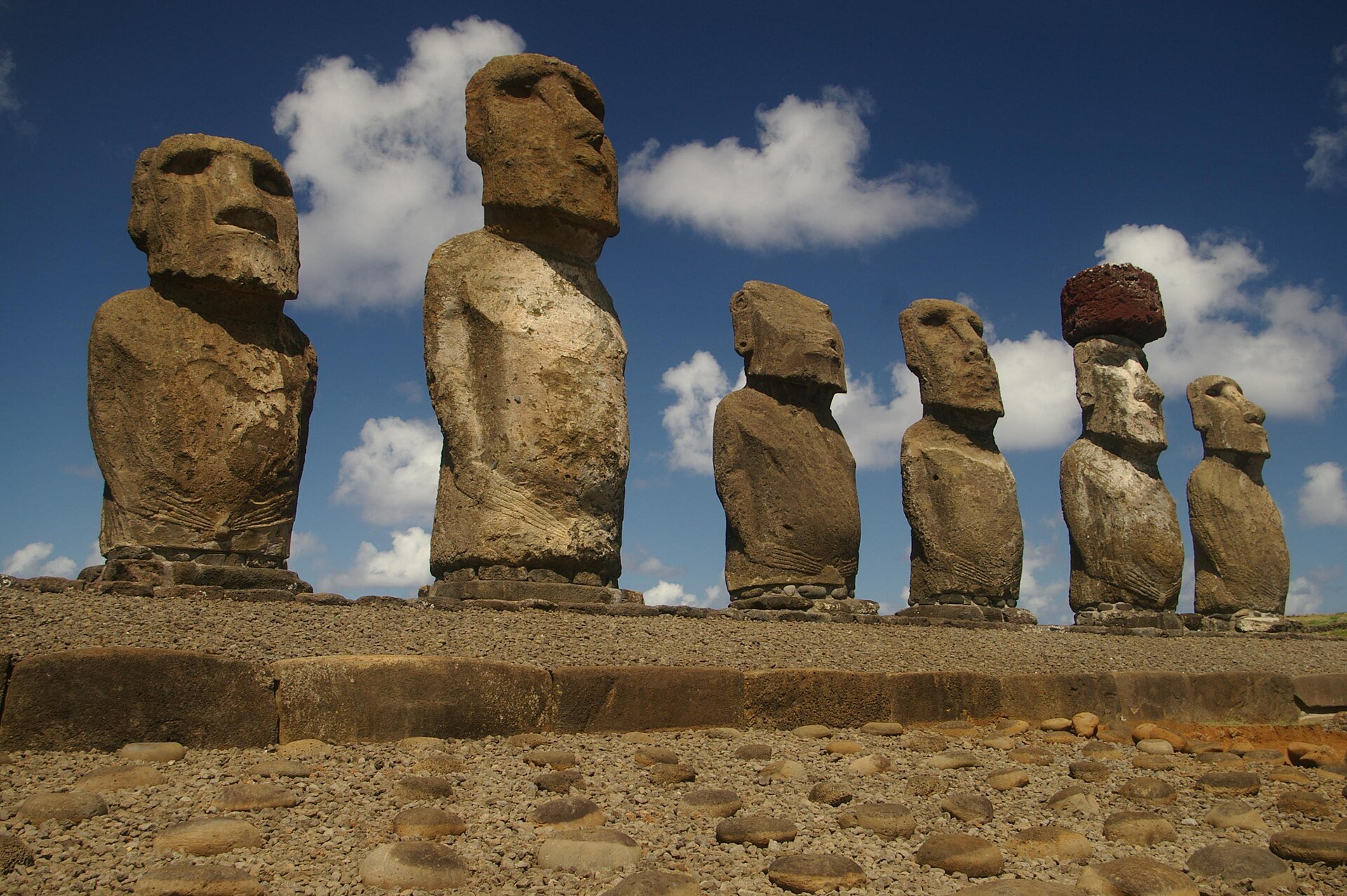
Why are giant stone heads on the loneliest island on Earth? Rapa Nui sits some 3,512 kilometres from mainland Chile — about as far from anywhere as an inhabited island gets — and it is crowded with statues. The Rapa Nui carved nearly 900 moai, the biggest heavier than a space shuttle. They walked them upright on ropes, rocked side to side, for miles. Hundreds still lie unfinished in the quarry. But they're not just heads — full bodies hide underground.
Watch the investigation
The Easter Island Short — "Why Are Giant Stone Heads on the Loneliest Island? 🗿" — is live on the channel.
Watch on YouTubeHeavier than a space shuttle
The Easter Island Statue Project has inventoried about 887 moai — "nearly 900" is the honest rounding — carved by the Rapa Nui roughly between the 13th and 16th centuries. Most stand on platforms around the island's coast. The largest, Paro, stands about ten metres tall and weighs some 82 tonnes — heavier than a Space Shuttle orbiter at roughly 78 tonnes empty. A small island society, working with stone tools, produced hundreds of these. Then moved them.
Key facts — Case File #047
- The place: Easter Island (Rapa Nui) — ~3,512 km from mainland Chile, one of the most remote inhabited islands on Earth.
- The statues: about 887 moai inventoried, carved roughly 13th–16th centuries.
- The biggest: Paro — ~10 metres tall, ~82 tonnes, heavier than a Space Shuttle orbiter (~78 t).
- The transport: walked upright, rocked side to side on ropes — proven by a moved 5-tonne replica (Lipo & Hunt, 2012).
- The quarry: Rano Raraku still holds ~400 moai in various stages of completion.
- The secret: excavated quarry "heads" have full buried torsos, some with petroglyphs carved on their backs.
They walked
How do you move an 82-tonne statue across an island with no machines and no wheels? The answer the islanders' descendants always gave sounds impossible until you test it: the statues walked. In 2012, researchers Lipo and Hunt showed how — a moai, stood upright and rigged with ropes, can be rocked side to side and shuffled forward, step by heavy step. They moved a five-tonne replica exactly this way. Scale the rope teams up, and the impossible transport mystery turns into a feat of rhythm and stubbornness: giants, walking the coast roads to their platforms.
Not just heads — bodies, underground
And then there's the quarry. Rano Raraku, where the moai were carved, still holds about 400 statues in every stage of completion, as if the carvers set down their tools one day and never came back. Its slope is studded with the famous buried heads — the island's most photographed faces. But when the Easter Island Statue Project excavated around those heads, they found the case's closer: the heads have bodies. Full torsos run underground, and some carry petroglyphs carved into their backs. For centuries, everyone photographed the heads. The statues were standing there whole the entire time — buried up to their necks in the quarry that made them.
Frequently asked questions
How many moai are there on Easter Island?
Nearly 900 — about 887 inventoried by the Easter Island Statue Project, carved by the Rapa Nui roughly between the 13th and 16th centuries. Around 400 more still lie unfinished in the Rano Raraku quarry.
How did the Rapa Nui move the moai?
They walked them. Experiments showed a moai can be moved upright, rocked side to side on ropes — a five-tonne replica travelled exactly this way. No machines, no wheels: rope teams and rhythm, for miles.
Are the Easter Island heads really just heads?
No. Excavations uncovered full torsos buried beneath the famous quarry heads, some with petroglyphs carved on their backs. The heads were only the visible part all along.
Keep exploring
- 🏛️ Angkor Wat: The Largest Temple on Earth Has No Name
- 🏔️ Machu Picchu: The City the Conquerors Never Found
- 🌊 The Lost Labyrinth of Egypt — the building witnesses swore had 3,000 rooms