
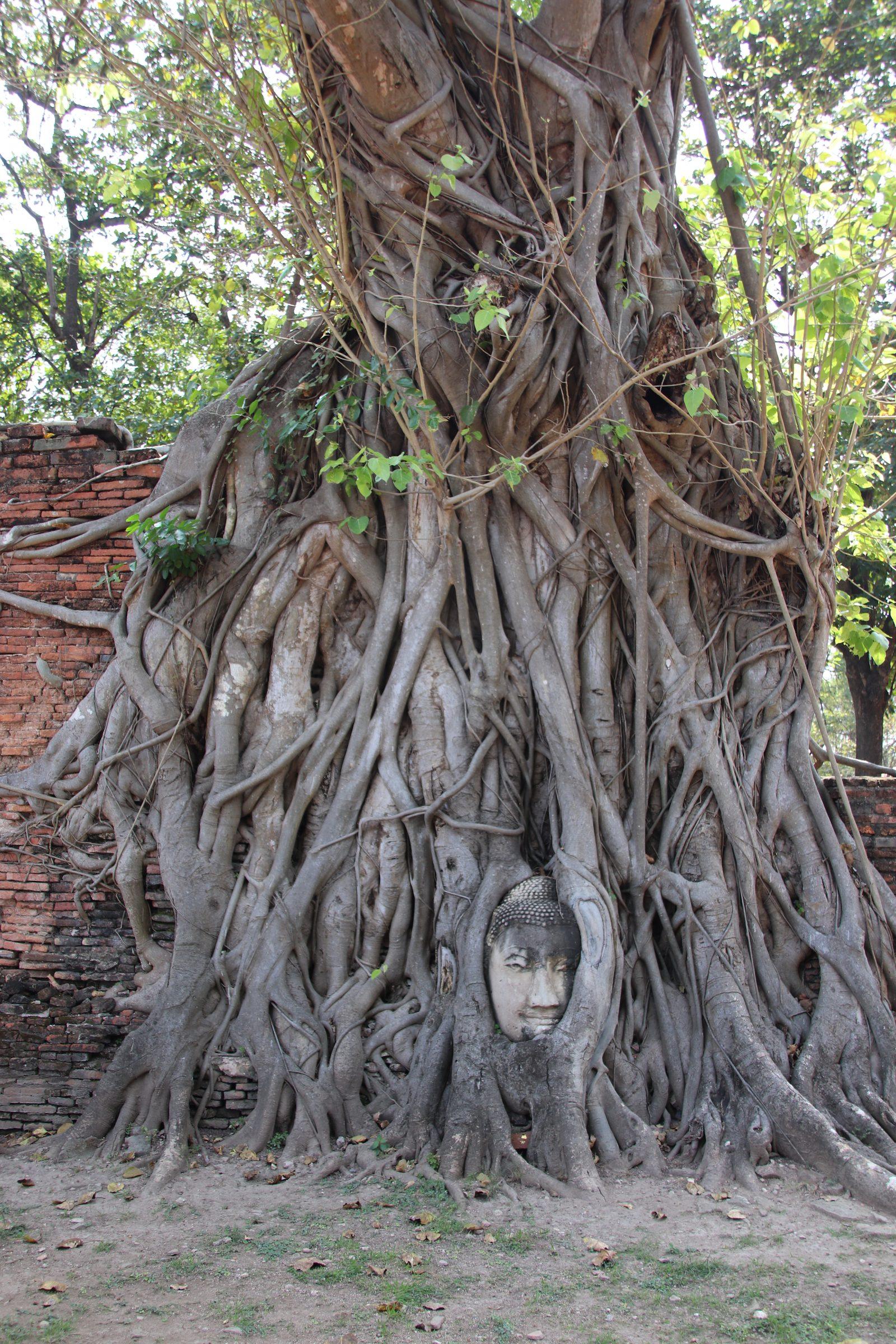
This city was swallowed twice — once by an army, and once by a tree. Ayutthaya, in Thailand, was one of the great capitals of the world for 417 years. Then, in a single year, it was razed to the ground and never rebuilt. What the army left behind, the jungle has been slowly, patiently swallowing ever since — and nowhere is that clearer than at Wat Mahathat, where a stone Buddha head sits wrapped in the roots of a tree, and nobody knows how it got there.
Watch the investigation
The Ayutthaya Short — "This City Was Swallowed Twice" — is live on the channel, and it's become our most-watched investigation yet.
Watch on YouTubeSwallowed by an army
For 417 years, Ayutthaya ruled Siam — a wealthy, glittering capital of temples and towers on an island where three rivers meet. In 1767, an invading army took the city and razed it. Capitals usually rise again from their own rubble. This one didn't. The court moved on, the people moved on, and the great city was simply left — its brick towers and headless statues standing in the open, exactly where they fell.
Key facts — Case File #146
- The place: Ayutthaya Historical Park, Thailand — the ruined capital of the kingdom of Siam.
- The reign: capital of Siam for 417 years.
- The fall: razed by an invading army in 1767 — and never rebuilt.
- The mystery: at Wat Mahathat, a Buddha head sits wrapped in tree roots. Nobody knows how it got there.
Swallowed by a tree
Walk the grounds of Wat Mahathat today and you'll find the city's most famous resident. A Buddha head — broken from its statue at some point in the city's fall — rests in the embrace of a great tree, its roots grown around the stone face over the years like fingers closing gently around something precious. The face is calm. The roots are patient. And the obvious question has no confirmed answer: how did the head end up in exactly the spot where a tree would one day lift and hold it?
That's the part of this case file I love most. The army's work took a year. The tree's work is still going on, one slow season at a time — proof that "swallowed" isn't always something that happens to a city in a day. Sometimes it takes centuries, and sometimes, at the end of it, the thing doing the swallowing is holding its prize like it means to keep it safe.
Frequently asked questions
How long was Ayutthaya the capital of Siam?
417 years — over four centuries as the capital of Siam, today's Thailand, before it fell in 1767.
What happened to Ayutthaya in 1767?
An invading army razed the city. It was never rebuilt — the capital moved elsewhere and the ruins were left standing.
How did the Buddha head get into the tree roots?
Nobody knows for certain. The head likely came to rest by the tree after the city fell, and the roots grew around it — but its exact journey into that spot is still an open question.
Keep exploring
- 🛕 Kailasa Temple: The Temple Carved From One Rock — Case File #104
- 🗿 Case File #060: Baalbek — the 800-ton stones nobody can explain
- 🏛️ The Lost Labyrinth of Egypt — 3,000 rooms still missing