
Every temple you've ever seen was built — stone stacked on stone, wall on wall. This one wasn't. At Ellora, in India, workers took a single cliff and carved down, cutting away everything that wasn't a temple, until towers, halls, pillars, and life-size stone elephants stood free in a pit of their own making. No blocks. No mortar. And no way to fix a single wrong cut.
Watch the investigation
The Kailasa Short — "This Temple Was Never Built — It Was Carved DOWN!" — is live on the channel.
Watch on YouTubeNever built — carved
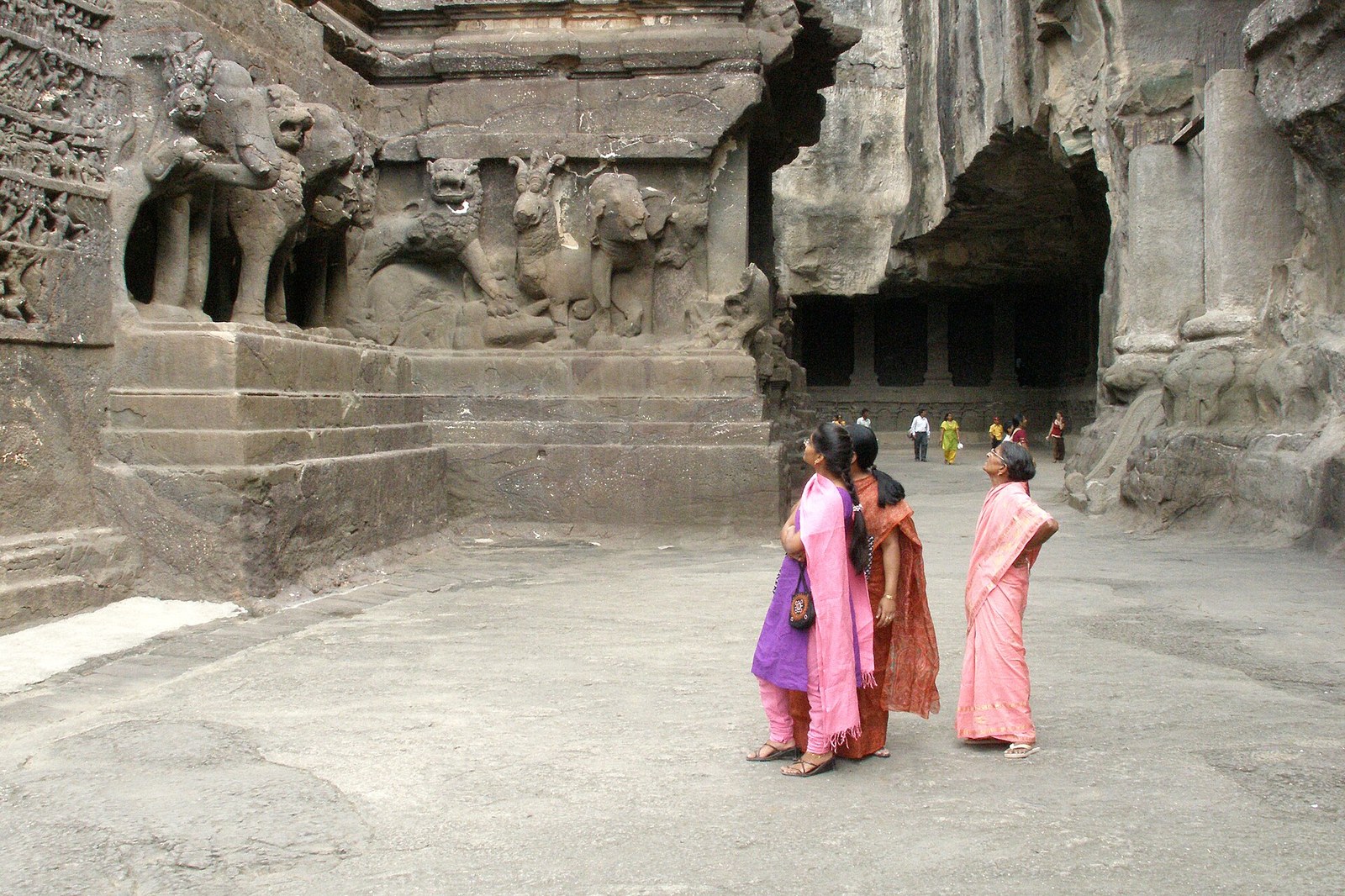
Stand in the courtyard of Cave 16 at Ellora and look up. The temple around you — a towering gateway, columned halls, a great shrine crowned with a carved peak — is not assembled. It is what was left. Workers began at the top of the basalt cliff and cut downward, trenching out a courtyard some 30 meters deep, then sculpting the temple out of the island of rock they left standing in the middle. The whole complex, all 32.6 meters of it, is one continuous piece of the original cliff.
Key facts — Case File #104
- The place: Cave 16 of the Ellora caves, Maharashtra, India — the largest rock-cut Hindu temple in the complex.
- The method: carved top-down from a single basalt cliff. Nothing was built up; hundreds of thousands of tons of rock were cut away.
- The patron: credited to Krishna I of the Rashtrakuta dynasty, 8th century CE.
- The dedication: to the Hindu god Shiva — Kailasa is his mountain home in the Himalayas, rebuilt here in stone.
- The scale: about 32.6 m high, in a courtyard cut roughly 30 m down into the cliff.
Top-down: the order that can't be undone
Think about what top-down carving demands of the people doing it. A builder who misplaces a block can pull it out and set another. A carver working down a cliff has no such mercy: every cut is final, every pillar and elephant exists only because no one ever cut one chisel-stroke too deep. The famous elephants along the plinth, the bridge between the gateway and the shrine, the tower itself — all of it had to be imagined, complete, inside solid rock before the first trench was dug, and then revealed without a single unfixable mistake.
That is the fact that keeps this case file open. Moving big stones is impressive. Subtracting a temple from a mountain — in the right order, at this scale, with hand tools — is a different kind of impressive altogether.
Frequently asked questions
How was the Kailasa temple made?
It was carved, not built. Workers started at the top of a basalt cliff and cut downward, removing hundreds of thousands of tons of rock to free a complete temple from the single living rock. Nothing was added; everything was taken away.
How old is the Kailasa temple?
It dates to the 8th century CE and is credited to the Rashtrakuta king Krishna I. It is dedicated to the Hindu god Shiva and named for his Himalayan home, Mount Kailasa.
How big is the Kailasa temple?
About 32.6 meters high, standing in a courtyard cut some 30 meters into the cliff — and the entire structure is one continuous piece of rock.
Keep exploring
- 🗿 Case File #060: Baalbek — the 800-ton stones nobody can explain
- 🌋 Mount Bromo: A Volcano Inside a Volcano — the wild place from today's expedition
- 🏛️ The Lost Labyrinth of Egypt — 3,000 rooms still missing