
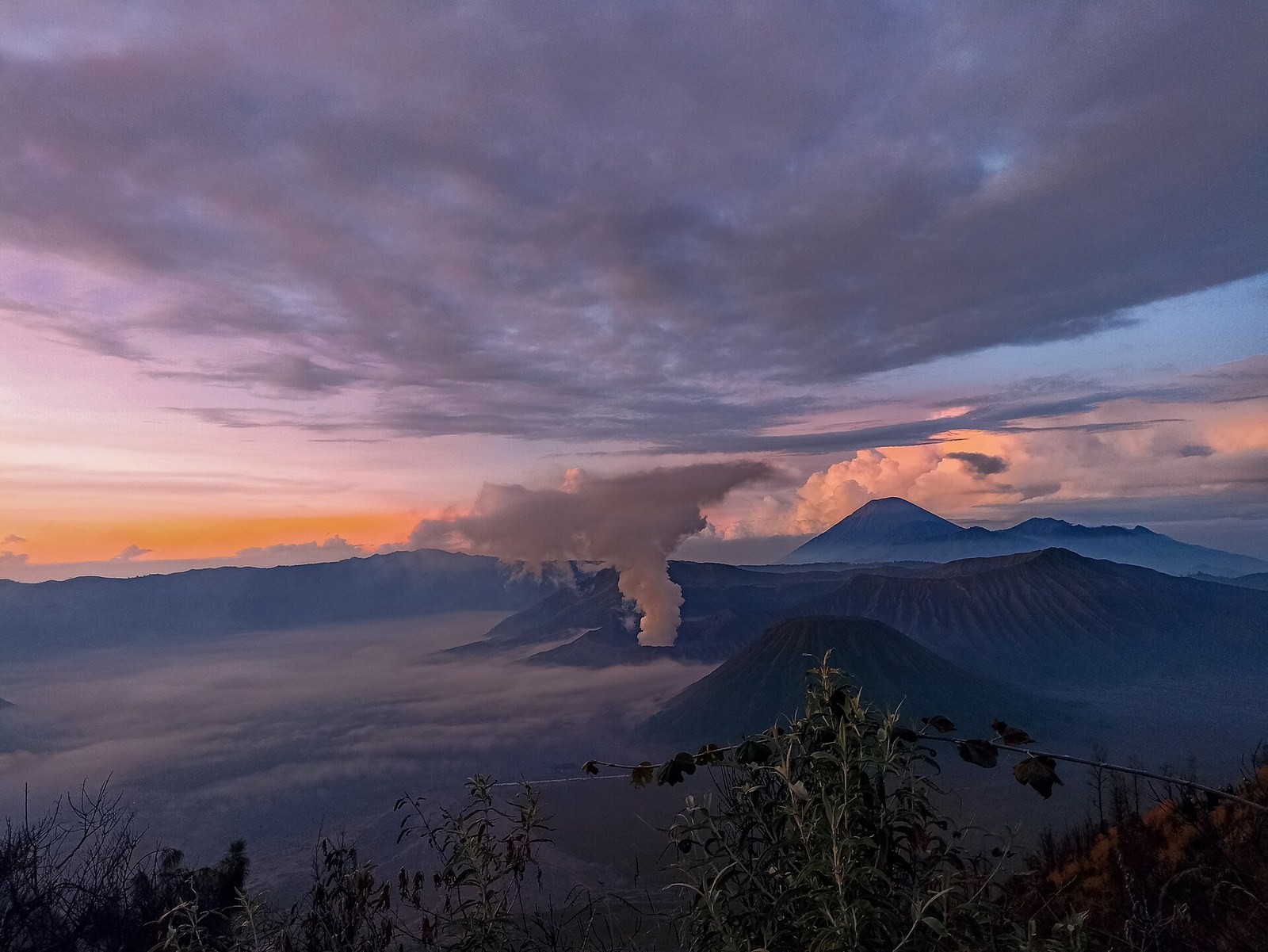
Some volcanoes had a mountain. This one has a mountain inside a mountain. Mount Bromo is a young, steaming, fully active volcano that grew up inside the crater of an ancient giant — in the middle of a flat grey desert called the Sea of Sand, on the island of Java, in Indonesia. And once a year, thousands of people climb to its rim before dawn and throw it presents.
Watch the investigation
The Mount Bromo Reel — "A Volcano Inside a Volcano!" — is live on Instagram, filmed from three real clips of the crater itself.
Watch on InstagramA volcano inside a volcano
Long ago, an enormous volcano stood here. It collapsed into itself, leaving a caldera — a crater roughly 10 kilometers wide, ringed by cliffs. Then the mountain-building started again: new cones rose from the caldera floor, and one of them, Bromo, is still awake. It steams all day, every day, sending a plume of sulphurous smoke up from its crater, while its perfectly shaped neighbor, Mount Batok, sleeps beside it and mighty Semeru — the tallest mountain on Java — looms behind.
Key facts — Case File #108
- The place: Bromo Tengger Semeru National Park, East Java, Indonesia.
- The setup: Bromo is an active cone inside the Tengger caldera — a crater about 10 km across left by an ancient, far bigger volcano.
- The Sea of Sand: the caldera's flat floor, a plain of grey volcanic sand the cones rise straight out of.
- The plume: Bromo emits sulphurous smoke constantly — the volcano is active and closely watched.
- The festival: at Yadnya Kasada, once a year, the Tenggerese climb to the rim and throw offerings into the crater.
Feeding the volcano: Yadnya Kasada
Once a year, the Tenggerese people who live around the caldera keep an appointment with the mountain. At the festival of Yadnya Kasada, they climb through the dark to Bromo's rim — up the steep stair cut into the cone — carrying offerings: fruit, rice, vegetables, flowers, livestock, even money. At the top, the offerings go over the edge, into the smoking crater, in honor of their ancestors and the mountain itself.
And because this is a real place full of real people, the story has a second act: below the rim, villagers wait with nets stretched out, hoping to catch an offering on its way down — a caught offering is considered lucky. Presents for the volcano, blessings for the quick-handed. It's a festival, a pilgrimage, and a geography lesson all at once: live next to an active volcano long enough, and respect for it becomes part of the calendar.
Frequently asked questions
Is Mount Bromo an active volcano?
Yes. Bromo steams constantly from its crater and is closely monitored. It is one of several young cones that grew inside the much older Tengger caldera.
What is the Sea of Sand?
The flat floor of the Tengger caldera — a plain of grey volcanic sand about 10 kilometers across, ringed by cliffs, with Bromo and its neighbor cones rising straight out of it.
Why do people throw offerings into Mount Bromo?
At the yearly Yadnya Kasada festival, the Tenggerese honor their ancestors and the mountain by throwing offerings — food, flowers, livestock, money — into the crater. Villagers below the rim wait with nets, hoping to catch one for luck.
Keep exploring
- 🛕 Kailasa Temple: The Temple Carved From One Rock — today's other expedition
- 🗿 Case File #060: Baalbek — the 800-ton stones nobody can explain
- 🐍 How to Tell a Coral Snake From a Look-Alike — the rhyme, and where it breaks